Get Full Government Meeting Transcripts, Videos, & Alerts Forever!
Get email alerts on the Energy Power Plants topic
No spam. Unsubscribe anytime.
Planning staff, PUC and residents debate ordinance to require conditional review for city power plants
Summary
Planning staff and city agencies discussed a proposed ordinance to require conditional use review for power plants in M1/M2 districts, with technical changes suggested by staff and the Public Utilities Commission; Bayview residents and advocacy groups urged caution and local hearings over environmental equity concerns.
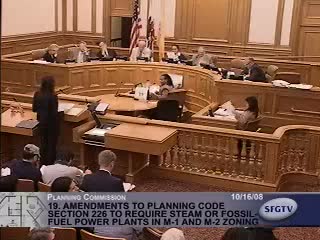
Planning Department staff and city agency representatives spent a large portion of the Oct. 16 Planning Commission meeting debating a proposed ordinance that would require conditional use authorization for power plants in M1 and M2 zoning districts.
Tara Sullivan of the Planning Department presented an informational briefing on the ordinance introduced by Supervisor Maxwell, saying staff supports the general aim — adding commission review for facilities currently permitted as‑of‑right — but asked for several technical changes. Staff recommended clearer triggers for when a plant would require review, broadening the definition of "power plant" to include all types, raising the small‑unit threshold (from 5 to 10 megawatts) to avoid capturing modest institutional cogeneration, and quantifying emission and assessed‑value thresholds that would trigger review.
Mike Martin, a development project manager at the San Francisco Public Utilities Commission who formerly worked in the City Attorney’s Office, said the PUC and mayor's office support staff’s revisions and supplied more detailed language to focus review on public‑safety and environmental‑sustainability questions. Martin said language that compares only raw megawatts can miss the operational benefits of quick‑start units that provide system reliability during peak demand and urged criteria that capture system‑level benefits and site‑specific alternatives.
Community members and advocacy organizations urged the commission to proceed carefully. Espanola Jackson of Bayview‑Hunters Point told commissioners the Southeast neighborhoods had long borne the burden of power plants and asked for hearings in Bayview so residents could see any changes in person. Joshua Arce of Bright Line Defense Project and other community advocates reminded the commission of a long campaign that led the city to avoid siting new combustion turbines in Southeast neighborhoods, and asked that criteria not be written in a way that would reinstate large in‑city plants without strong community process.
Commissioners asked technical questions about the numerical thresholds in the draft — for example a 5 percent versus 10 percent change trigger and a 25 percent assessed‑value test — and whether emergency or short‑term operations would be covered. Staff said the policy applies to both new and existing facilities; on siting jurisdiction they noted that state siting bodies cover very large plants (generally above about 50 MW) while the city must still consider smaller installations and retrofits in its land‑use review.
No formal action was taken at the Oct. 16 meeting; staff circulated revised text during the hearing and indicated commissioners would see the item again for possible action at the next hearing. Commissioners and the PUC said they would provide more objective, quantified language to help predictability for applicants and the public while preserving ability to block proposals that pose unacceptable community impacts.