Get Full Government Meeting Transcripts, Videos, & Alerts Forever!
Get email alerts on the Air Quality topic
No spam. Unsubscribe anytime.
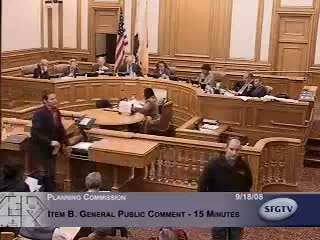
Planning Commission forwards air‑quality measure to supervisors after hours of debate
Summary
The Planning Commission voted 4–2 to forward an ordinance that would require air‑quality assessments and, in some cases, ventilation upgrades for new infill residential projects in roadway exposure zones. Public-health officials said modeling of PM2.5 can identify where mitigation is needed; developers and builders raised cost and implementation concerns.
The San Francisco Planning Commission voted to forward to the Board of Supervisors a proposed ordinance requiring air‑quality assessments — and performance‑based indoor ventilation in some cases — for new urban‑infill residential projects in mapped roadway exposure zones.
The commission’s 4–2 vote on Sept. 18 followed a two‑hour presentation by Planning Department and Department of Public Health staff and more than an hour of questions from commissioners and public testimony. Planning staff recommended approval with modifications, including adopting the exposure map with the legislation and requiring interagency review of technical rules.
Dr. Rajeev Bhatia of the Department of Public Health described the ordinance’s technical approach: parcels would be screened using a dispersion model that focuses on fine particulate matter (PM2.5). Where a modeled roadway contribution exceeds an action threshold, projects of 10 units or more would pay for an assessment (staff estimate: about $1,500) and, if the assessment shows levels over the threshold, would be required to meet a performance standard that removes roughly 80 percent of outdoor PM2.5 from indoor air.
"Air pollution exposure is higher when you get closer to the source," Dr. Bhatia said, describing studies that link roadway proximity to increases in childhood respiratory illness. He added that the Department of Public Health and Planning want a map adopted with the ordinance so developers and decision‑makers know which parcels are affected.
Builders and trade groups warned of higher construction costs and technical obstacles. John O’Connor of the Real Property Association estimated ventilation work could run substantially higher than staff’s low‑end figures for some buildings and urged more time to study costs. Questions focused on whether modeling — not year‑round sampling — is adequate and whether the requirement should extend to smaller existing buildings.
Planning Director Rama told commissioners the measure is not mandatory for the commission to review but recommended giving the Board the Planning Commission’s technical advice. City Attorney Kate Stacy reminded the commission that if plans change substantively after submission, CEQA recirculation could be required.
Commissioner comments ranged from calls for more study of costs to arguments that the ordinance is a necessary public‑health intervention. "This is a public‑health issue," Commissioner Olague said, urging the city to move forward. Commissioners Antonini and Moore voted no.
The ordinance will next be considered by the Board of Supervisors, with the planning department and public‑health staff expected to refine technical rules, the exposure map and any implementation fees as the measure moves through the legislative process.