Get Full Government Meeting Transcripts, Videos, & Alerts Forever!
Get email alerts on the Taxi Medallions topic
No spam. Unsubscribe anytime.
Board accepts continued review of disabled taxi applicant’s challenge to SFMTA driving rule
Summary
A disabled medallion applicant challenged the San Francisco Municipal Transportation Agency—s 800-hour driving requirement as violating the Americans with Disabilities Act. After hours of testimony and legal argument, the Board of Appeals continued the case to its indefinite calendar to allow administrative and legal processes to proceed.
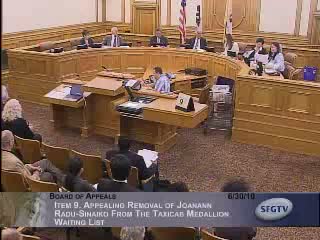
The San Francisco Board of Appeals on June 30 took no final vote on a challenge by Joan Ann Radu Soneiko to the city—s taxi medallion eligibility rules, instead continuing the case to the board—s indefinite calendar as SFMTA and the applicant pursue administrative and legal avenues.
Soneiko, a taxi driver who says she lives with a long-term disability, asked the board to direct SFMTA to modify its 800-hour-per-year driving eligibility rule or to grant an accommodation that would let her obtain a medallion and drive a baseline number of hours subject to annual review. Ray Alexander, her lawyer, argued that federal disability law requires individualized modifications unless the agency can show a proposed change would fundamentally alter the program. "The ADA is the law of the land," Alexander said during oral argument.
Jarvis Murray, taxi section staff for the San Francisco Municipal Transportation Agency, told the board the driving requirement is codified in the transportation code and is an essential eligibility condition for holding a medallion. Murray said courts have affirmed the requirement—s role in limiting absentee ownership and ensuring drivers— experience: "The driving requirement has been codified in the transportation code... We don't want absentee ownership," he said.
The hearing featured extended exchanges about whether the appeals board may override or effectively change a policy adopted by the MTA and the board of supervisors, and about how federal ADA precedent applies to applicants versus current medallion holders. The board discussed prior case law, including litigation known in the hearing as Sloan, and the difference between temporary accommodations granted to existing medallion holders and what may or may not be offered to applicants.
After questions about alternatives and possible interim accommodations, the board voted to continue the matter to the board—s indefinite calendar (call of the chair) so the parties can pursue administrative remedies and for the board to revisit the case later if needed. The action preserves the appellant—s right to pursue other remedies while postponing a final board ruling.
Next steps: the appeal remains open and may return to the board once administrative reviews or related court decisions clarify the legal framework.