Get Full Government Meeting Transcripts, Videos, & Alerts Forever!
Get email alerts on the Land Use topic
No spam. Unsubscribe anytime.
Planning staff says downtown has capacity for housing but falls short on office space under 'smart‑growth' forecasts
Summary
Planning staff told the commission that a 25‑year baseline forecast and an ABAG 'smart‑growth' projection show downtown can absorb housing from the pipeline but would lack sufficient office capacity to meet the higher smart‑growth job projections; commissioners asked staff to add a 50/50 alternative and deeper workforce housing profiling to EIR work.
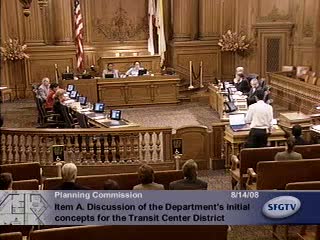
Planning Department staff told the San Francisco Planning Commission on Aug. 14 that while the city’s downtown has substantial capacity for new housing, it lacks sufficient capacity to meet higher forecasts for office job growth.
Joshua Switsky, planning staff, outlined two 25‑year brackets used in the analysis: a baseline scenario based on historical trends and forecasters such as Moody’s and REMI, and a higher “smart‑growth” scenario that follows ABAG regional assumptions directing more growth into urban cores. Switsky said the baseline projects roughly 58,000 citywide office jobs and about 17 million square feet of office demand through 2035; the smart‑growth scenario projects about 107,000 office jobs and more than 32 million square feet citywide. He said that downtown currently contains roughly 73% of the city’s office stock and that, after subtracting approved and under‑construction projects, the downtown faces a large unmet office demand under both scenarios and especially under the smart‑growth projection.
"These are not set in stone," Switsky said, adding that the analysis is an initial framework to inform land‑use recommendations and EIR alternatives. He recommended concentrating job space near the city’s regional transit facilities and exploring controls that would require a minimum amount of commercial (office) space on very large new sites.
Commissioners pressed staff on several follow‑up issues. Commissioner Bill Lee asked that the EIR include a 50/50 office‑to‑housing alternative so decision‑makers retain flexibility and so the Transbay Joint Powers Authority could evaluate tradeoffs for financing the terminal, noting that greater housing could increase affordable‑housing yields. "If we give you more housing, we want 20 or 25% affordable," Lee said, urging staff to include that option in the environmental alternatives.
Commissioner Mike Antonini asked whether the baseline relied solely on historical averages or segmented market forecasts; Jessica Vang, the consultant from Seifel Consulting, said the baseline aligns with historical growth but the team also interviewed brokers and developers and examined indicators such as venture capital flows to test who might occupy new office space.
Staff said they netted out approved, under construction, and programmed projects to derive unmet demand. Under the baseline downtown capture assumption the office unmet demand was on the order of millions of square feet; under the smart‑growth capture the unmet office demand was substantially larger. By contrast, staff said the downtown pipeline and current approvals leave more than enough capacity to absorb housing in the baseline scenario and still significant capacity under the smart‑growth scenario.
Several commissioners asked staff to return with more specific demographic and workforce profiling — who will live in new units, average earnings, and how new residents might affect demand for neighborhood retail and services — and requested copies of the Seifel report for additional review. Staff said the EIR notice of preparation has been published and that the draft plan and EIR are expected to be available for public review in late 2008 and early 2009, respectively.
The commission did not take formal votes on policy changes at the meeting. Commissioners asked staff to consider additional analysis (including a 50/50 scenario and more detailed jobs–housing balance work) at an upcoming hearing.