Get Full Government Meeting Transcripts, Videos, & Alerts Forever!
Get email alerts on the Eastern Neighborhoods topic
No spam. Unsubscribe anytime.
Planning Commission reviews Eastern Neighborhoods EIR, debates Mission Street setbacks, fees and PDR protections
Summary
The San Francisco Planning Commission heard staff presentations and public comment on certification of the Eastern Neighborhoods final EIR and a package of rezonings and policies, focusing debate on potential loss of PDR, transit and intersection impacts, Mission Street upper-story setbacks, pipeline fees and proposed incentives for integrated PDR (iPDR).
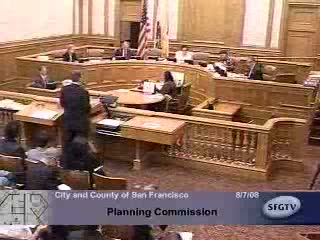
The San Francisco Planning Commission on Aug. 7 took up certification of the final environmental impact report (EIR) for the Eastern Neighborhoods Rezoning and Area Plans (case no. 2004-0160E) and a linked package of rezonings, interim controls and fees, receiving extended public comment and debating several unresolved technical and policy choices.
Planning staff urged the commission to certify the EIR as adequate and to forward zoning and policy recommendations to the Board of Supervisors. "With the certification motion, in essence, the commission certifies the EIR as adequate, accurate, and complete," Planning environmental staff Michael Jacinto told commissioners, summarizing the DEIR release on June 30, 2007, the 76-day public comment period that closed Sept. 14, 2007, and the department39s response-to-comments document published May 29, 2008.
The EIR, Jacinto said, identifies several impacts that staff could not reduce to less-than-significant, including a potential loss of production, distribution and repair (PDR) uses, significant unavoidable transit impacts on seven Muni bus lines, service degradation at nine intersections and possible significant effects to historic architectural resources and shadows on parks; staff has drafted a statement of overriding considerations in accordance with CEQA.
Public commenters reflected the split on certification. "I encourage you to certify the final EIR," Jeffrey Leibovitz of East Soma said. By contrast, members of the Coalition for San Francisco Neighborhoods urged delay: "The Planning Commission and the Board of Supervisors cannot amend the general plan and the planning code without a valid housing element that is in compliance with state law," Hiroshi Fukuda, chair of the coalition's land-use and housing committee, read from the group's resolution. Other commenters raised concerns about the EIR's transportation baseline and about downzoning effects on existing buildings and seismic upgrades.
Commissioners pressed staff on several discrete policy choices tied to the plan. On Mission Street, staff recommended an upper-story setback that would create a 65-foot predominant street-wall and a minimum 10-foot setback above that level to protect solar access and street character. Commissioner Christina Olague and others pressed for greater modulation and a higher minimum (15 feet) to preserve street quality; Commissioner Bill Lee and others warned that larger setbacks at the 65-foot level would reduce buildable area and could cost housing units.
The commission also debated interim "pipeline" fees and springing conditions for projects in the planning pipeline. Staff presented options that would use a January cut-off with graduated fees; commissioners discussed an interim residential fee near $4 per square foot (with $10 adopted for later projects) and whether nonresidential impact fees should also apply in the interim. Craig Adelman from the mayor39s Office of Housing attended for a colleague and deferred to planning staff for quantifying potential loss of units under different setback scenarios.
Staff introduced integrated PDR (iPDR) policies and an associated fee proposal that would include incentive options: a sliding-scale rebate (25% to 50%) for meeting specified hiring goals in an enterprise zone within five years and installment payment plans (three to seven years) for conversion or legitimization fees. Commissioners asked staff to return with explicit sliding-scale thresholds and clearer language to include in the resolution sent to the Board.
Several technical corrections and map adjustments were also discussed: staff proposed modest height-limit corrections in UMU districts to preserve 15-foot clear ground floors (e.g., raising a 45-foot cap to 48 feet in parts of Showplace Square), and Sue Exline described an expansion of the Showplace Square open-space concept area to allow more acquisition options. Commissioners debated storefront depth minimums in NCT/N C districts (staff referenced roughly 15% retail depth as a workable baseline).
Procedural matters: earlier in the meeting the commission voted to continue an extensive list of calendar items to later dates and, before acting on the Eastern Neighborhoods EIR, recorded recusals: a motion to recuse three commissioners from the EIR vote was moved and approved, and those members left the dais for portions of the Eastern Neighborhoods discussion.
What happens next: staff said the packet before the commission is the package they plan to forward to the Board of Supervisors, including resolutions, motions and code language; staff will return with clarified fee tables and more precise iPDR incentive language per commissioners' requests. The commission recessed to allow distribution of additional materials and to take the remainder of public comment and formal actions later in the agenda.