Get Full Government Meeting Transcripts, Videos, & Alerts Forever!
Get email alerts on the Billboard Permit topic
No spam. Unsubscribe anytime.
Board leaves DBI denial of billboard deconstruct‑and‑replace permit intact after split vote
Summary
After contested expert testimony on powder‑post beetle infestation and tenant health risks, the Board of Appeals failed to reach the four‑vote threshold to overturn DBI and Planning denial of a full deconstruct‑and‑replace permit for a billboard at 1633–1649 Haight Street; the denial stands.
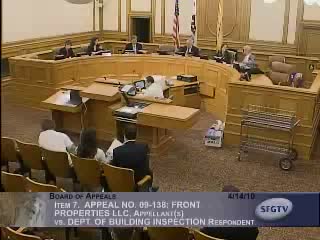
The San Francisco Board of Appeals reviewed April 14 whether to allow a deconstruct‑and‑replace permit for a billboard at 1633–1649 Haight Street and, after hearing competing termite and mold reports and tenant health concerns, was split and therefore left the department’s denial in place.
DBI Senior Building Inspector Joe Duffy reported from an on‑site inspection that visible termite or beetle damage was concentrated in the bottom two horizontal rails of the billboard’s framework and recommended those members be replaced while leaving the remainder of the structure in place and treated if appropriate. “The only part of it that should be deconstructed and replaced is the bottom 2 horizontal members of the framework,” Duffy said.
Opposing counsel for the property owner (Front Properties) argued that the site showed broader infestation and cited technical reports from independent consultants, including a report from Paul Markoff that identified powder‑post beetle infestation in upper rails when the sign covering was removed. Markoff told the board that fumigation options were impractical and that topical chemical treatments would have low efficacy; he recommended removing affected wood and replacing it with pressure‑treated materials.
CBS Outdoor, which holds the billboard interest, and its pest‑control consultant (Terminix) testified that infestation and decay were limited and treatable: Terminix’s representative said borate treatments have low acute toxicity and that heat treatment is a non‑toxic alternative. Tenants living above the billboard expressed concern about spraying chemicals and possible evacuation if toxic treatments were used.
The board considered public‑safety and tenant health alongside DBI’s narrow repair recommendation and the complexities of the city’s billboard regulatory regime. Commissioner discussion highlighted competing technical evidence and concerns about potential taking of property rights if permissions to remove signs were used to extinguish rights attached to buildings.
When the board put the motion to overturn the department’s denial, the roll call produced a 2‑2 split; the charter requires four votes to overturn a departmental action, so the denial was sustained.
What happens next: the department’s denial remains in effect; parties may pursue repairs consistent with DBI direction or seek further administrative relief.