Get Full Government Meeting Transcripts, Videos, & Alerts Forever!
Get email alerts on the Landmarks Charter topic
No spam. Unsubscribe anytime.
Planning Commission opposes Landmarks charter amendment as drafted, asks for multiple‑entitlement safeguards
Summary
After public testimony and staff briefings, the Planning Commission voted 6–1 to oppose a proposed charter amendment creating an independent Landmarks Preservation Board unless the measure is revised so the Planning Commission retains authority in multiple‑entitlement cases; commissioners raised Prop M, appeals, and process concerns.
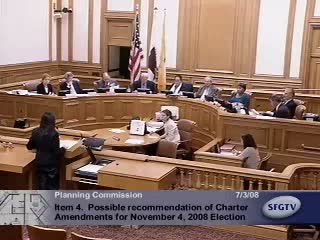
The San Francisco Planning Commission voted 6–1 on July 3 to oppose a proposed charter amendment that would create an independent Landmarks Preservation Board unless the measure is revised to preserve the Planning Commission’s role on "multiple entitlement" cases.
Commissioner Mike Antonini moved the formal position after a lengthy staff briefing and public comment. "Absent modifications to the multiple entitlement issue to allow the Planning Commission to have jurisdiction on multiple entitlement cases, the Commission would not be able to support the charter amendment," Antonini said during debate.
The commission’s action followed a staff summary of the latest draft and public testimony that highlighted competing city priorities. Planning Department staff member Tara Sullivan told the panel the draft gives the Landmarks Board new duties including review and comment on CEQA and NEPA documents and authority to direct historic surveys. "The Landmarks Board shall review and comment on all CEQA... documents, NEPA," Sullivan said, summarizing a new paragraph added to the proposal.
Preservation and planning advocates sharply disagreed on the draft’s likely effects. "This Landmarks legislation has the effect of gutting Proposition M," preservation consultant Deborah Stein told the commission, arguing the draft would elevate preservation above the master plan’s other priority policies and give the new board near‑veto power over projects that must balance preservation against housing or sunlight protections.
Staff and commissioners explored several technical fixes. Planning staff said the supervisor at Rules Committee signaled willingness to amend the language governing the general plan preservation element so the Planning Commission would remain the “final author” of plan elements while the Landmarks Board would review and comment first. Staff also noted that an appeals route to the Board of Supervisors would remain, but several commissioners said that the appeals path did not fully address their concerns about process and balancing among competing master‑plan priorities.
The motion that passed called for the commission to oppose the charter amendment in its current form unless it is modified to return certain multiple‑entitlement authorities to the Planning Commission and to address concerns commissioners raised about appointments and board composition. The roll call recorded Moore, Lee, Antonini, Miguel, Bridal and President Olague voting "aye," with Commissioner Seguaya voting "no."
The commission asked staff to transmit the comments to the Rules Committee and to continue discussions with the supervisor’s office; staff said it would take additional comments back to the Rules Committee, which was scheduled to reconvene the item the following week.
No changes to the charter amendment were enacted by the commission itself; the vote was a recommendation and the amendment remains subject to revision by the Board of Supervisors and to further Rules Committee action.