Get Full Government Meeting Transcripts, Videos, & Alerts Forever!
Get email alerts on the Urban Forestry topic
No spam. Unsubscribe anytime.
Board upholds USF request to remove two large cypress trees on safety grounds
Summary
The Board of Appeals upheld Department of Public Works Urban Forestry's approval for the University of San Francisco to remove two mature Monterey cypress trees near Masonic Avenue, citing structural defects and a high target rating for failure.
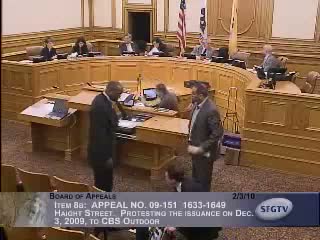
The San Francisco Board of Appeals on Feb. 3 voted unanimously to uphold the Urban Forestry Bureau’s permit allowing the University of San Francisco to remove two mature Monterey cypress trees along Masonic Avenue, citing public‑safety concerns.
Curtis Speck and a group of neighbors submitted petitions and urged the board to preserve and properly maintain the trees; he presented a community plan to monitor and support replacement plantings. “We look at ourselves also, so we ask of ourselves ... speak clearly and with compassion,” Speck told commissioners while presenting more than 200 petition signatures.
The university and its ISA certified arborist, Juan Carrasco, testified that the trees showed substantial defects, declining canopies and multiple stems with tight angles of attachment that increase the risk of trunk or stem failure. Carrasco told the board, “It will be catastrophic if one of these large pieces of the tree will break and will go down into the University or Masonic Avenue, or the bus stop that is located.” DPW Urban Forestry staff said one of the trees already had a cable that failed after a leader failed and that routine pruning would not correct the structural defects.
Several neighborhood speakers urged pruning and monitoring rather than removal; tree advocates warned of loss of canopy and wildlife habitat. DPW acknowledged the community’s desire to retain canopy and recommended vigorous replacement planting and improved maintenance for younger trees planted on the site.
After hearing technical testimony including a pest/structural expert and the university’s maintenance plan, the board voted 4–0 to uphold the urban forestry permit authorizing removal, citing the combination of large tree size, structural defects and public‑safety considerations. The University said it will proceed with removal and has existing reforestation plans to replace mature canopy over time.