Get Full Government Meeting Transcripts, Videos, & Alerts Forever!
Get email alerts on the Noise And Zoning topic
No spam. Unsubscribe anytime.
Board of Appeals pauses rooftop‑bar enforcement as planning review continues
Summary
On Feb. 10 the San Francisco Board of Appeals continued a notice‑of‑violation hearing for the rooftop restaurant at 2516–2524 Mission Street to the board—s indefinite calendar to allow Planning—s conditional‑use process to proceed; neighbors and the owner clashed over noise, jobs and possible penalties.
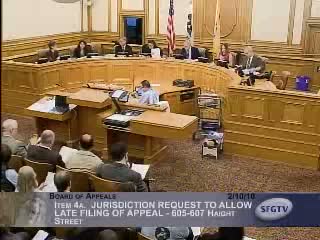
SAN FRANCISCO — The San Francisco Board of Appeals on Feb. 10 declined to rule on a notice of violation tied to the rooftop restaurant and bar at 2516–2524 Mission Street, instead continuing the case to the board—s “call of the chair” calendar while the Planning Commission considers a conditional‑use (CU) authorization.
Planning staff told the board they had received as‑built drawings and a sound‑attenuation memo and estimated a CU hearing could be scheduled in roughly 60 days if the applicant files a complete application. Scott Sanchez of the Planning Department said, “once we get a complete application…60 days out would be a reasonable time for the CU hearing,” and that the department—s policy is usually not to pursue enforcement while a remedy is pending.
Owner representatives said they were revising plans and working on mitigation. Attorney Brett Gladstone, representing the property sponsor, warned of economic consequences if the board upheld the notice of violation: “If you were to uphold that tonight, of course, the deck would immediately have to close down,” he said, arguing such an outcome could cost jobs.
Neighbors and community groups, led by representatives of the San Francisco Buddhist Center, urged the board not to shortcut environmental review and to resolve noise and usage limits through the CU process. Viveka Chen, chair of the Buddhist Center, said the group—s outreach showed sustained noise complaints and urged a full CU review rather than a categorical exemption.
Much of the hearing centered on two competing concerns: the department—s and neighbors— desire for enforceable limits on hours, capacity and sound levels, and business groups— warnings about jobs and the economic effect of immediate closure. Planning staff noted that if the board issues a decision upholding penalties, accrual of fines would begin with the board—s notice of decision; Scott Sanchez said planning—s penalty code allows fines of up to $250 a day but that the code limits reductions to no less than $100 a day.
After extended public comment from residents, business owners and neighborhood groups, Commissioner Fung moved to continue the matter to the call of the chair with the public hearing held and closed and with no additional briefing. The motion passed 3–2. The board—s action preserves the NOV while allowing the CU process to play out at Planning, leaving enforcement modalities and any fines to be determined by the department and, if necessary, the city attorney.
What happens next
Planning staff said they will send formal application requirements to the project sponsor and that a CU hearing could be scheduled roughly 60 days after the Department receives a complete application. The Board of Appeals— decision to continue removes an immediate ruling by this board and leaves enforcement discretion with Planning and DPH for the period while the CU process proceeds.