Get Full Government Meeting Transcripts, Videos, & Alerts Forever!
Get email alerts on the Planning Fees And Charter topic
No spam. Unsubscribe anytime.
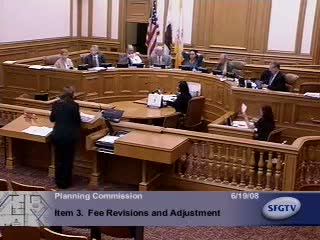
Planning Commission Advances Fee Increases, Inclusionary Refund Changes and Backs Charter Amendment Modifications
Summary
After a staff presentation on revenue shortfalls, the commission approved a three‑part fee package including reduced inclusionary refund incentives tied to proportional share, modest COLA-based fee adjustments, and a change to community plan fee recovery; commissioners also voted to forward staff-recommended modifications to a set of charter amendments on landmarks, entertainment policy, and the Commission for the Environment.
The Planning Commission voted to advance a package of fee changes and to forward staff‑recommended modifications to several charter amendments that affect the Landmarks Preservation structure, music and culture policy, and the Commission for the Environment.
Elaine Forbes of the Planning Department presented three linked fee proposals intended to help stabilize department revenue amid a citywide deficit. The measures would: 1) change the inclusionary‑housing planning-fee refund so refunds are tied to the proportional share of below‑market units rather than a blanket 100% refund; 2) apply an across‑the‑board fee adjustment (1.63%) to keep pace with labor cost growth in addition to a legislated cost‑of‑living adjustment; and 3) require fuller citywide recovery for community plan EIR work in adopted plan areas (including programmatic EIR cost recovery) and update various billing practices. Staff said the combined changes are projected to generate roughly $2.5 million for the department and reduce pressure for staff reductions.
Public commenters raised concerns. John Bartos warned against penalizing appellants and said the idea of billing appellants for frivolous appeals would chill public participation; staff clarified that the proposed ordinances as drafted do not include a frivolous‑appeal billing provision and that the suggestion would require Board of Supervisors action. Developers and project sponsors asked for clearer flowcharts and process memos to explain how a streamlined community plan process would actually speed review and limit costs, especially for projects that implicate historic‑resource reviews.
Commissioners asked for and received clarifications about historic‑resource fee splitting (a two‑part fee for initial determination and subsequent substantial‑adverse‑change analysis), appeal fee waivers for neighborhood organizations and low‑income appellants, and a proposed $500 appeal fee for conditional uses and CEQA appeals (with refund on successful appeals). The commission motioned to approve the three fee measures and to recommend that the Board of Supervisors develop criteria for what constitutes a frivolous appeal before any billing provision is adopted; that motion was approved by the commission.
On charter amendments, staff briefed the commission on proposed changes to create an independent Landmarks Preservation Board, a music and culture amendment to accelerate implementation of entertainment‑related policies, and an amendment expanding advisory powers for the Commission for the Environment. Commissioners expressed mixed views: some supported independent commission status for landmarks and clearer seats tied to professional expertise, while others cautioned against removing too much Planning Commission oversight and urged safeguards (including supermajority thresholds when Planning would overturn Landmarks recommendations). The commission voted to forward staff‑recommended modifications and to express sympathy for a revised Exhibit A2 that emphasizes planning-code implementation rather than immediate general-plan authoring by a single‑issue commission. The proposed Commission for the Environment amendments were supported with minor clarifications limiting scope to larger policy questions and specifying coordination procedures.
What’s next: The fee ordinances and recommended charter amendment amendments will be forwarded to the Board of Supervisors along with the commission’s recommended language and clarifications.