Get Full Government Meeting Transcripts, Videos, & Alerts Forever!
Get email alerts on the Land Use Zoning topic
No spam. Unsubscribe anytime.
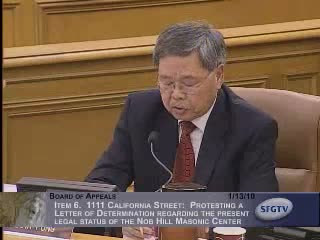
Board upholds zoning administrator’s determination for 1111 California St.; declines to accept late briefs
Summary
The San Francisco Board of Appeals upheld the Zoning Administrator’s letter of determination that the California Masonic Memorial Temple’s current use is nonconforming, and voted not to accept supplemental briefs filed after the record closed. The board left broader questions about future uses to the Planning Commission.
President Frank Fung and the five-member San Francisco Board of Appeals on Jan. 13 refused to accept written materials filed after the Dec. 9, 2009 hearing and voted to uphold the Zoning Administrator’s letter of determination for 1111 California St., the California Masonic Memorial Temple.
The board first debated whether accepting new briefing after a closed hearing would require reopening the public hearing. Zoning Administrator Larry Badner told the board the planning memo had been submitted to answer a question posed at the prior hearing; appellant counsel Alice Barclay and Stephen Vettel said they preferred the board decide tonight without accepting new filings. President Fung moved to exclude all party briefing submitted after Dec. 9, and the motion passed 4–1.
Following that procedural vote, Commissioners deliberated on the substantive question — whether the zoning administrator erred or abused discretion in finding the building currently a nonconforming use. Vice President Tanya Peterson told colleagues she had reviewed the record and was inclined to let the letter of determination stand and direct questions about expanded or changed uses to the Planning Commission. Commissioner Michael Garcia moved that the board uphold the zoning administrator’s determination; the roll call did not reach the four votes required to overturn the determination, and the board left the zoning administrator’s determination in place.
Why it matters: The board’s decision preserves the Zoning Administrator’s finding that the building’s current use is nonconforming, which limits immediate changes in allowable activities at the site. The board also signaled that broader policy decisions about the property’s future uses and any requests for expanded activity are matters for the Planning Commission’s discretionary review.
What happens next: With the letter of determination left intact, any party wishing to pursue different uses or a change in status will generally need to seek relief or modifications through the Planning Commission process or by bringing a properly noticed, record-based appeal.
Quotes and sources: Vice President Tanya Peterson said she was “leaning towards the side of upholding the letter of determination and letting questions of additional use go to the Planning Commission.” President Frank Fung moved to exclude post–Dec. 9 materials, explaining the board needed to preserve the integrity of the record. Planning Department staff and appellant representatives both addressed the board during the hearing.
Authorities referenced: Planning Code Section 3.17 (soundness thresholds) and procedural rules governing closed hearings and admission of late materials.