Get Full Government Meeting Transcripts, Videos, & Alerts Forever!
Get email alerts on the Medical Cannabis topic
No spam. Unsubscribe anytime.
Board continues appeal by Alternative Patient Cooperative; DPH urges delivery-only option
Summary
The Board of Appeals continued the appeal by Alternative Patient Cooperative after the Department of Public Health defended its denial of a medical cannabis dispensary permit over inaccessible restroom access. DPH told the Board APC could seek an expedited delivery-only permit; the Board continued the hearing to Feb. 10 so APC can pursue that route.
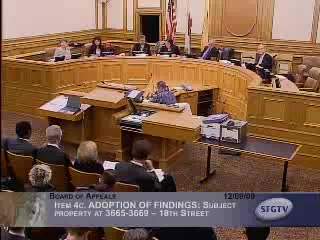
The San Francisco Board of Appeals on Dec. 9 continued an appeal by the Alternative Patient Cooperative (APC) after the Department of Public Health (DPH) urged the cooperative to seek a delivery-only permit rather than be exempted from access standards. The Department’s deputy city attorney told the Board the permit denial was tied to APC’s failure to meet minimum access standards in San Francisco Health Code section 3.308(y) and that the health code contains no broad exemption for the cooperative’s landlord dispute.
“The permit was denied because APC failed to comply with the minimum disabled standards contained in Section 3.308, subdivision Y of the health code,” DPH counsel Terrence Howzel said, adding that DPH has applied those standards uniformly to other medical cannabis dispensaries. Howzel said DPH had advised APC previously that it could apply for a delivery-only Medical Cannabis Dispensary (MCD) permit and that the department could expedite that request.
APC’s attorney, Patrick Goggin, and the cooperative’s manager Kevin Patchen described financial and landlord obstacles that they said made compliance difficult. “I spent a lot of money to get this permit, and I’m totally without a permit,” Patchen said, describing the business consequences for employees and patrons.
Board members questioned whether the dispute was primarily with the landlord rather than the city’s rules and discussed whether staying enforcement while APC pursues a delivery‑only option would be equitable. DPH and program staff said a delivery-only permit is available and that in practice it exempts the operator from the access‑on‑site requirements in section 3.308. DPH program director Kessler said staff believed APC could qualify for a delivery‑only permit quickly and that the department could process it promptly if APC applied.
After discussion, the Board voted to continue the public hearing and keep the record closed so APC could seek a delivery‑only MCD permit; the continuance was set for Feb. 10, 2010 (4‑0). The continuance preserves the department’s notice-of-decision timing while allowing APC time to pursue alternatives DPH outlined.
What happens next: APC can apply immediately for a delivery‑only MCD permit; according to testimony the process involves fees and basic plan review (DPH cited a tax-collector fee around $4,000/year and standard departmental signoffs). If APC instead seeks full bricks‑and‑mortar service, the cooperative would have to pursue conditional or code‑based remedies and would continue to face the access requirements spelled out in section 3.308(y).
The Board’s action keeps open both the department’s authority to enforce access requirements and APC’s ability to seek an alternative operating mode while the matter returns in February.