Get Full Government Meeting Transcripts, Videos, & Alerts Forever!
Get email alerts on the Eastern Neighborhoods Complete Neighborhoods topic
No spam. Unsubscribe anytime.
Planning staff present 'Complete Neighborhoods' proposals for Eastern Neighborhoods
Summary
Planning Department staff outlined proposals to guide 7,500 new units in San Francisco’s Eastern Neighborhoods, emphasizing Transit First objectives, targeted open‑space acquisition, design controls and a funding gap between roughly $250 million in likely revenue and a $400 million program need.
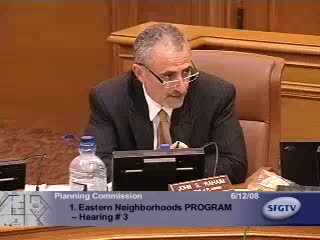
San Francisco Planning Department staff on June 12, 2008 presented the "Complete Neighborhoods" chapter of the Eastern Neighborhoods area plans to the Planning Commission Committee, focusing on transportation, open space, historic preservation and design controls meant to support an estimated 7,500 new housing units across four subareas.
The presentation, led by Eastern Neighborhoods project manager Ken Rich and transit staff from the SFMTA, framed proposals around the city's Transit First policy and a policy-level vision that prioritizes public transit, walking and bicycling. Staff said they have a reasonably reliable revenue estimate of about $250,000,000 over 20 years but that the full program of transportation, open-space and other public benefits would cost roughly $400,000,000, leaving a gap staff said they would seek to close through additional funding strategies.
Why it matters: the plan rewrites land-use and design expectations across East SoMa, the Mission, Showplace Square/Potrero Hill and the Central Waterfront. Staff emphasized that many elements remain at a policy level and that implementation — design, engineering, environmental clearances and funding — will follow separate studies and projects.
Key elements and staff estimates - Transit: Britt Tanner of the SFMTA summarized short-term Transit Effectiveness Project proposals that would increase rapid-service frequency on key corridors, extend the 22 Fillmore trolley to the UCSF Mission Bay campus, expand limited service on the Mission Corridor and create a two‑way downtown circulator. Tanner said the TEP is a five‑year roadmap and that the public comment period on its proposals closes June 15. - EN TRIPS funding: staff announced an Eastern Neighborhoods Transportation Implementation Planning Study (EN TRIPS) funded at about $1,250,000 (including a $750,000 Metropolitan Transportation Commission grant) to move specific street and transit designs through engineering and environmental clearance. - Open space: the plan proposes three open‑space types (new parks/plazas, reclaimed right‑of‑way and private open space). Staff described a proposal of roughly one new open space and one renovation per neighborhood in a full‑buildout scenario and said private open‑space requirements would be 80 square feet per unit by default, with a 54 square‑foot incentive level for spaces made publicly accessible; use of an in‑lieu fee would be allowed only with demonstrated hardship. - Historic resources: staff said surveys are underway (complete for the Central Waterfront; finishing in fall 2008 elsewhere) and proposed interim preservation rules while surveys finish, including landmark review for some tall or CEQA‑triggered projects and report requirements for proposed exterior alterations. - Urban design: planning staff presented mid‑block bulk controls, alley protections to maintain light and air, required active ground floors on designated streets, and principles that relate allowable heights to street widths and transit corridors.
Staff stressed process and timing: Rich asked commissioners to begin giving direction before the next hearing cycle; staff said the detailed implementation package and a more technical transportation/pipeline discussion will be taken up at the June 19 hearing and again when the package goes to the Board's Land Use Committee.
Selected staff quotes "We have a scaled back program... but what we're going to do now is present to you the full program," Ken Rich said as he showed funding options and gaps. "The public comment period is ending June 15," Britt Tanner said of the TEP proposals.
What comes next: staff said the EIR and implementation program will define specific funding commitments, design contracts and environmental clearances, and they flagged a likely July 10 target for certification of the Eastern Neighborhoods decisions after follow‑up hearings and refinements. The committee deferred the detailed implementation presentation to the June 19 meeting and asked staff to return with further analysis on funding linkages and project phasing.