Get Full Government Meeting Transcripts, Videos, & Alerts Forever!
Get email alerts on the Housing Funding topic
No spam. Unsubscribe anytime.
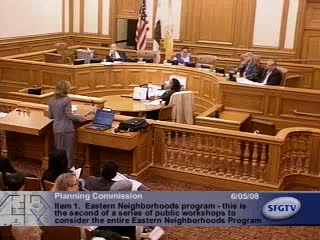
Planning staff lays out inclusionary options and tiered impact fee to fund Eastern Neighborhoods public benefits
Summary
Planning staff and the Mayor’s Office of Housing described a package of inclusionary options, a tiered Eastern Neighborhoods impact fee and potential grant and tax‑increment tools to pay for parks, transit, and affordable housing; staff estimated $100–150 million from fees plus other sources but opponents warned the fees approach the limit of market feasibility.
Planning Department staff and the Mayor’s Office of Housing presented detailed proposals for how the Eastern Neighborhoods rezoning would fund parks, transit and affordable housing, centering on a tiered impact fee and higher inclusionary requirements.
Doug Shoemaker of the Mayor’s Office of Housing said the city’s housing priorities remain supportive housing, affordable rental housing for seniors and low‑income families, and targeted homeownership for middle‑income households. He described three inclusionary approaches under consideration: higher percentage inclusionary requirements in the Urban Mixed Use (UMU) zone, a land‑dedication alternative in lieu of on‑site units, and a modest middle‑income homeownership option targeted to a small share of sites. Shoemaker said the Mayor’s Office typically manages about $50 million a year in capital resources citywide and that the office expects roughly 30% of such funds could end up in the Eastern Neighborhoods under current assumptions.
Sarah Dennis of the Planning Department explained the public benefits package the fee would support: one new park and one park renovation per neighborhood, a network of green streets, transit/pedestrian/bicycle improvements, neighborhood business support, community facilities and increased affordable housing. She walked the commission through the department’s nexus and feasibility analyses and presented a tiered impact fee structure designed to align with the development potential created by rezoning. Dennis described a baseline fee presented to the commission as roughly $8 per gross square foot (with alternative net/adjusted figures discussed), additional higher fee tiers for projects that receive larger height or density increases, and separate tiers for non‑residential uses. The staff’s estimate based on an EIR development scenario of about 7,500 units projected fee revenue in the $100 million–$150 million range; combined with existing funded projects ($30–$50 million) and potential grants ($100–$125 million), staff said the plan could capture roughly $250 million toward a partial public‑benefits program.
Staff emphasized the difference between a legal “nexus” (the maximum justifiable fee) and the fee level that is financially feasible for projects. "Nexus is the legal umbrella under which you're allowed to charge fees," Shoemaker said, noting a high nexus does not by itself mean a market will bear that fee. The feasibility study informed staff recommendations that scale fees down from the nexus maximum to levels the department judged likely to permit continued development while producing neighborhood improvements.
Why it matters: the funding package and inclusionary options are central to whether the rezoning will deliver both new housing and neighborhood improvements without unduly stalling market activity. Staff presented modeling and ranges rather than hard guarantees; they proposed monitoring and a program ordinance to track outcomes and agency responsibilities after plan approval.
What’s next: staff invited further technical review (Bridal/Bridal Consulting and Seifel Consulting availability on future dates was noted) and scheduled follow‑up hearings on implementation details, monitoring mechanisms and the complete‑neighborhood program. Commissioners and public commenters asked staff to provide additional prototypes showing where fees could impede feasibility and to clarify how existing capital commitments and grant strategies would be coordinated.