Get Full Government Meeting Transcripts, Videos, & Alerts Forever!
Get email alerts on the Window Replacement topic
No spam. Unsubscribe anytime.
Board upholds Planning Department’s denial of vinyl window legalization for Sutter Street property
Summary
After hearing conflicting accounts from the property owner, contractor, DBI and planning staff, the Board of Appeals upheld the Planning Department’s letter of determination and permit denial for vinyl window replacements at 2520–2522 Sutter Street; a motion to overturn failed to meet the four-vote charter threshold.
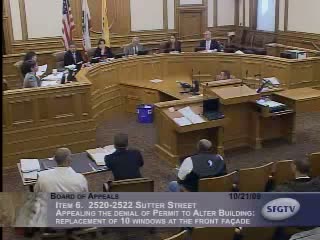
The San Francisco Board of Appeals on Nov. 2 upheld the Planning Department’s decision denying legalization of recently installed vinyl windows at 2520–2522 Sutter Street.
Scott Sanchez (Planning Department) told the board the windows replaced original wood or compatible materials with vinyl that “did not meet the residential design guidelines” (Planning Code §3.11 and the department’s Window Replacement Standards) and that the work was done without an appropriate planning review. He said the building, constructed circa 1900, may be a historic or potential historic resource and that the department had issued a notice of violation on June 6, 2009 after inspectors found work exceeding the scope of kitchen-remodel permits.
Appellant Donald Copeland said he inherited the project, paid to bring the property ‘‘up to code,’’ and relied on his contractor and on prior interactions with city staff. His contractor and witnesses described inconsistent messages from department staff about whether a planning review was required. DBI Deputy Director Lawrence Kornfield described an accessible front counter, printed standards and an initial-permit-review process intended to flag projects needing planning review.
Vice President Peterson moved to overrule the letter of determination and the denial; the roll call produced a 3–2 vote to overrule. Because the City Charter requires four votes to overturn a department action, the board concluded the department’s letter of determination and the permit denial remain upheld.
Commissioners urged the appellant to explore available energy-efficiency or community programs to offset replacement costs and said the factual record suggested the contractor’s conduct—rather than Department of Building Inspection policy—was central to Copeland’s hardship.
The decision leaves in place planning’s finding that the visible street-facing windows are subject to planning review and that the vinyl windows failed to comply with the applicable design guidance.