Get Full Government Meeting Transcripts, Videos, & Alerts Forever!
Get email alerts on the Election Policy topic
No spam. Unsubscribe anytime.
Deputy city attorney warns Planning Commission of broad effects of Propositions 98 and 99
Summary
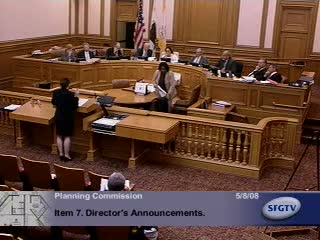
Deputy City Attorney Susan Cleveland Knowles briefed the Planning Commission on Propositions 98 and 99 (June 3, 2008 ballot), explaining that Prop 98 could limit eminent domain, phase out rent control and put many planning and environmental regulations at risk; Prop 99 is narrower and could supersede Prop 98 if it receives more votes.
Deputy City Attorney Susan Cleveland Knowles gave an informational briefing to the Planning Commission on Propositions 98 and 99, two statewide ballot initiatives on the June 3, 2008 ballot that aim to restrict eminent domain after Kelo.
Cleveland Knowles explained that Proposition 98 is broader: it would ban taking private property for private economic development with few exceptions, add procedural and definitional hurdles for eminent domain, and include provisions that could be interpreted to phase out local rent control and to limit the city’s ability to require inclusionary housing, impact fees, CEQA mitigation, and even certain environmental or open‑space condemnations. She cautioned that the initiative’s language is ambiguous in places and would likely produce litigation to determine scope and interpretation.
By contrast, Proposition 99 targets only owner‑occupied residences taken for conveyance to private parties and includes a public health and safety exception. It also contains a so‑called ‘poison‑pill’ provision so that if both pass but 99 receives more votes, 98 would be superseded.
Commissioners asked clarifying questions about just compensation, how impact fees or mitigation might be characterized under the initiative’s definition of “private economic benefit,” and the potential for litigation. The deputy city attorney said courts would ultimately interpret ambiguous language but flagged the range of planning and regulatory tools that could be affected, including zoning, environmental review, fees, and historic or environmental protections.
Andrew Schwartz, counsel for League of Conservation Voters, testified during public comment that the combination of measures could roll back multiple environmental and land‑use protections and urged scrutiny of the potential effects on the city’s planning tools.