Get Full Government Meeting Transcripts, Videos, & Alerts Forever!
Get email alerts on the Eastern Neighborhoods topic
No spam. Unsubscribe anytime.
City officials and advocates clash over future of industrial land in Eastern Neighborhoods plan
Summary
Planning staff and the Mayor’s Office of Economic and Workforce Development presented competing visions for the Eastern Neighborhoods: preserve core PDR (production, distribution, repair) lands or allow measured flexibility to attract hybrid 'clean‑tech' and creative firms. Dozens of speakers urged either stronger protections or more flexibility; commissioners asked staff for more data and monitoring tools.
SAN FRANCISCO — The Planning Commission on May 22 heard an extended presentation and an equally lengthy public backlash over the Eastern Neighborhoods plan and how it should treat the city’s remaining industrial (PDR) lands.
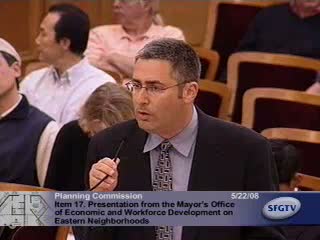
Michael Cohen, director of the Mayor’s Office of Economic and Workforce Development, told the commission the office supports the plan’s goal to protect PDR but urged “enough flexibility to allow innovation and growth by newly emerging hybrid companies” that blend office, production and prototype work. Cohen’s team recommended zoning tools such as limiting conventional office by floor in PDR districts, allowing up to 33% accessory office in PDR areas, and creating a narrow “innovative industries” overlay where NAICS/NEXC codes could be used to exclude traditional law‑firm style office uses.
The proposal was framed as a jobs strategy: MOEWD, using labor‑market data, said many of the fastest‑growing, good‑paying positions for people without four‑year degrees now appear in hybrid and technology‑adjacent fields rather than in traditional heavy manufacturing.
“Many of the industries most likely to meet the plan’s objectives do not fit neatly into traditional categories of light industrial or office,” Cohen said, urging a balance between preserving industrial character and allowing firms that create middle‑wage jobs to grow in city neighborhoods.
That argument drew immediate pushback from PDR advocates, labor groups and neighborhood representatives who warned that loosening land‑use protections would accelerate displacement of existing industrial businesses and the workers they employ.
“PDR space needs to be protected for those jobs that exist today,” said Eric Casa of the Mission Anti‑Displacement Coalition during the public comment period. “We can’t rebrand office uses as ‘innovation’ and call it preservation.”
Speakers on both sides used numbers and local examples to make their case: opponents pointed to longstanding small manufacturers, artists’ studios and repair shops that provide entry‑level, often immigrant jobs; supporters pointed to local firms such as Sustainable Spaces and FUSE as examples of firms that need flexible, mixed spaces to grow.
Commissioners pressed staff for more concrete supply‑and‑demand data. Planning staff said vacancy and demand studies differ widely: in the Eastern Neighborhoods alone the department’s vacancy snapshot was cited at about 0.9%, while other analyses covering Bayview and other industrial areas show higher available capacity. City staff and MOEWD said they were working on tools, including using business classification (NEXC) codes, to monitor actual business types and better target policy responses.
The meeting produced no final zoning changes but highlighted the core tradeoff at the center of the Eastern Neighborhoods effort: how to preserve remaining PDR jobs and space while accommodating new, higher‑growth users that can create middle‑income employment. Commissioners asked staff and the Mayor’s Office to continue refining definitions, provide clearer vacancy and pipeline figures, and model adaptive‑reuse costs for historic buildings to better weigh protections against conversion.
Next steps: the commission recessed Eastern Neighborhoods hearing items to future dates (June 5 and June 12 were discussed) to allow staff to produce additional analyses and to continue public engagement. No zoning action was taken May 22.