Get Full Government Meeting Transcripts, Videos, & Alerts Forever!
Get email alerts on the Hospital Rebuild topic
No spam. Unsubscribe anytime.
Neighbors press Planning Commission on helipad, asbestos and construction risks at SFGH draft EIR hearing
Summary
The Commission opened public comment on the draft EIR for the proposed San Francisco General Hospital rebuild. Speakers praised the hospital’s mission but voiced strong concerns about a proposed helipad, asbestos/soil disturbance during construction, noise, traffic and loss of open space; staff set a written comment deadline and will respond in a comments-and-responses document.
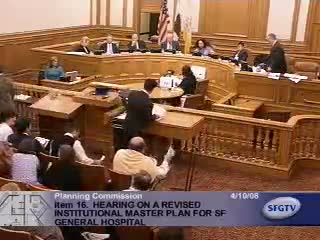
The Planning Commission held a public hearing on the draft environmental impact report (EIR) for the proposed replacement acute‑care hospital at San Francisco General Hospital (SFGH), taking oral comments while the written comment period remained open through April 22, 2008.
Planning staff said the draft EIR analyzes a proposed 7‑story (plus two basement levels), ~422,000‑square‑foot hospital with about 284 acute beds, required to meet SB 1953 seismic standards. The EIR treats a rooftop helipad as a separate project for environmental review, and the IMP revision presented to the commission states the helipad would not be located on the new hospital roof. The draft EIR found potential significant unavoidable impacts to a potential historic district and, under cumulative conditions, to the US‑101 southbound off‑ramp at Potrero Avenue.
Members of the public — including neighbors, hospital staff and neighborhood groups — delivered extensive testimony. Concerns recorded in the hearing included:
• Helipad and noise: Neighbors said a helipad near patient rooms would raise aircraft noise exposures and sleep disturbance; speakers asked whether air ambulance use would primarily serve San Francisco residents or bring patients from outside the city. "I do not support a helipad at SFGH," a neighborhood speaker said during public comment.
• Construction‑phase hazards: Multiple speakers raised alarm about serpentine rocks and asbestos in shallow soils on Potrero Hill and urged a detailed, enforceable construction‑phase plan (air monitoring, real‑time controls) for excavation. One commenter referenced preliminary sampling showing friable asbestos at shallow depth and asked for core sampling to full construction depth.
• Open-space loss and rooftop mitigation: The draft EIR notes a net loss of roughly 43,000 square feet of usable open space on campus; opponents argued a rooftop garden cannot replace ground-level green space for neighborhood use and will be too cold and windy to be effective.
• Traffic and access: Commenters flagged potential worsening of existing congestion at Potrero/20th/Third, pedestrian safety and ambulance routing during construction; the EIR found the project contributes to a significant cumulative impact on the US‑101 off‑ramp.
Hospital officials, including CEO Jean O’Connell, described program needs driving the hospital layout and emphasized coordination with planning staff: the new hospital design targets improved patient safety (base-isolated structure) and modern clinical adjacencies. Hospital staff also explained a near-term replacement of unreliable steam‑turbine emergency power with diesel emergency generators that will be tested weekly and used only for power outages.
Next steps: The Planning Department is accepting written comments until 5 p.m. on April 22, 2008; comments will be transcribed, and the department will prepare a formal comments‑and‑responses document and revised EIR as required by CEQA. The Commission and staff flagged follow‑up actions: provide clearer analysis of retrofit alternatives and retrofit cost assumptions, sharpen the construction‑phase asbestos/air‑quality mitigation plans, and provide additional shadow/noise/traffic maps for neighborhood review.
Sources: Draft EIR presentation and public testimony at the April 10 Planning Commission meeting; Jean O’Connell, SFGH, and multiple neighborhood speakers.