Get Full Government Meeting Transcripts, Videos, & Alerts Forever!
Get email alerts on the Backstreets Pdr topic
No spam. Unsubscribe anytime.
Backstreet Business Advisory Board urges city steps to retain San Francisco’s light‑industrial businesses
Summary
Supervisor Sophie Maxwell and the Backstreet Business Advisory Board presented a report urging the city to take coordinated steps — on business assistance, land‑use certainty, infrastructure, workforce training and employer development — to retain light‑industrial and PDR (production, distribution, repair) jobs in San Francisco’s southeast and corridor areas.
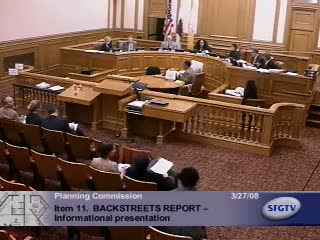
Supervisor Sophie Maxwell opened the Commission’s presentation on the Backstreet Business Advisory Board report, saying the group was created to draw attention to the city’s small industrial and service businesses that provide steady middle‑income jobs.
The board’s chair, Peter Cohen, summarized the project and the report’s approach: mapping a “hidden” industrial footprint concentrated in the southeast sector and along major corridors, identifying 12 subsectors of activity, and pressing policymakers to treat PDR (production, distribution, repair) uses as a distinct element of the local economy. “Who bakes our sourdough bread?” Cohen asked rhetorically, underscoring the everyday supply‑chain roles these businesses play.
The report framed recommendations in six categories. Mark Clayman, one of the advisory board presenters, described the package: (1) business assistance and a single city point of contact to navigate permits; (2) proactive attraction and retention (not necessarily tax breaks); (3) clearer land‑use protections and buffering so industrial users can make long‑term investments; (4) targeted infrastructure improvements and the need to address “unaccepted streets” that lack regular maintenance; (5) stronger employer‑side workforce development and vocational pathways; and (6) formation of an industrial business alliance to give PDR firms a collective voice.
Board members and business owners told commissioners that many of these companies already pay good wages and supply the region, but are vulnerable to rising land costs and uncertain zoning. Todd Rufo of the Mayor’s Office of Economic and Workforce Development described the city’s role as a single point of contact and a connector to incentives, real‑estate opportunities and workforce programs.
Why it matters: the report puts specific policy options on the table as the city prepares wider land‑use and Eastern Neighborhoods decisions. Commissioners indicated interest in follow‑up: staff will circulate the board’s materials and the commission may ask departments to explore the enforcement and infrastructure items the board highlighted.
What’s next: the report will be part of the Planning Department’s record as the commission and other city bodies weigh zoning and neighborhood plans in the coming months.