Get Full Government Meeting Transcripts, Videos, & Alerts Forever!
Get email alerts on the Economic Development topic
No spam. Unsubscribe anytime.
City leaders present economic plan; planners and commissioners debate Eastern Neighborhoods zoning and PDR protections
Summary
City staff presented an economic development plan under Proposition I that prioritizes job growth, stable revenues and retained middle-income employment. Commissioners and the Comptroller—s office debated how Eastern Neighborhoods rezoning and PDR (production/distribution/repair) zones could help or hinder keeping knowledge-sector firms and middle-income jobs in San Francisco.
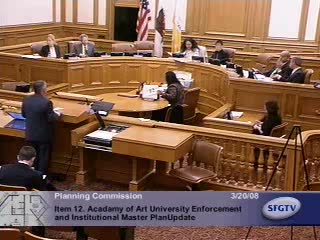
San Francisco—s Office of Economic and Workforce Development and the Comptroller—s Office briefed the Planning Commission on March 20 on a city economic plan implementing Proposition I, framing four priorities: more jobs and faster job creation, better mid- and lower-income job pathways, more stable tax revenues and a strategy to help firms grow and stay in the city. Michael Cohen, director of the Office of Economic and Workforce Development, described the plan as a framework tying land-use policy to economic goals; Ted Egan, the comptroller—s chief economist, summarized findings that the city has lost middle-income jobs and that growth has been concentrated at the high and low ends of the wage scale.
Egan told commissioners the plan identifies two export sectors—a "knowledge" sector (technology, biotech, design) and an "experience" sector (tourism and visitor services)—that drive San Francisco—s economy. He said land use is a key tool: "Urban land provides access to all of these [economic] foundations and affects the cost of doing business," and warned that zoning choices in the Eastern Neighborhoods could restrict the ability of knowledge firms to expand in place.
Commissioners spent most of the session pressing staff on the plan—s assumptions and implications. Commissioner Christina Olague and others asked whether restricting office space inside proposed PDR areas could push growing firms out of the city. Egan conceded the draft Eastern Neighborhoods plan "restricts the opportunity to expand the range of knowledge sector industries" by limiting office development in some industrially zoned areas, and proposed further economic-impact study to measure how PDR rents and jobs would respond to the rezoning.
Commissioners also raised workforce and equity concerns. Commissioner Michael Antonini asked what the plan would do to produce reliable tax revenues without over-relying on payroll taxes, which he said can push firms to move work elsewhere. Egan and Cohen said the plan included a sector-based approach (targeting biotech, digital media and green tech) and workforce development measures to connect non-college workers to higher-paying jobs, but emphasized that retraining and a long-term workforce strategy would be needed.
The presentation underscored several tradeoffs for the Planning Commission: preserving PDR space to retain middle-income production jobs versus allowing more flexible office and mixed uses to enable knowledge firms to grow in San Francisco. Staff pledged follow-up analysis on PDR employment density, the possible unintended effect of restrictive office rules on land values, and the interactions among zoning, transit access and industry clustering. The commission asked staff to return with more detailed economic impact studies and to coordinate land-use choices with the workforce and economic strategy as the Eastern Neighborhoods plan proceeds.