Get Full Government Meeting Transcripts, Videos, & Alerts Forever!
Get email alerts on the Brownfields Remediation topic
No spam. Unsubscribe anytime.
Board upholds Schlage Lock demolition with DTSC condition after brownfield debate
Summary
After lengthy testimony about soil contamination and safeguards, the Board of Appeals upheld demolition permits for the Schlage Lock site at 2201 Bayshore Boulevard but conditioned approval on DTSC sign‑off of air monitoring, dust control and soil management plans before slabs or foundations can be removed.
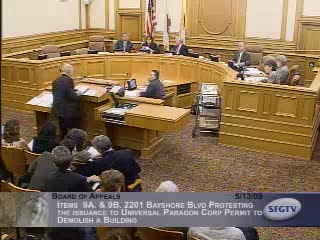
The San Francisco Board of Appeals voted May 20 to uphold demolition permits for the Schlage Lock redevelopment at 2201 Bayshore Boulevard while imposing a condition that building slabs and foundations not be removed until the Department of Toxic Substances Control has approved air‑monitoring, dust‑control and soil‑management plans.
Appellant counsel Robert Garcia told the board the demolition could expose adjacent properties to volatile organics and other soil contaminants, calling the site a "toxic Brownfield" and arguing that Mr. Brahma Swamy’s small residential property would bear disproportionate risk and loss. "To give them this permit at this time is like giving them permission to deconstruct the mummies," Garcia said, urging stricter conditions and compensation for loss of use.
Representing the project sponsor, Alan Abshes of Greenberg Troward said demolition and remediation planning has been ongoing for a decade, hazardous building materials had already been removed and that BP/Brownfield Partners and contractors are coordinating with DTSC, the Air Quality Management District and Department of Public Health. "There are no explosives, no wrecking balls," Abshes said. He offered to accept a condition that slabs and foundations not be removed until regulatory agencies approve the required plans.
Karen Toth of the Department of Toxic Substances Control, who has worked on the Schlage Lock site since 1994, described monitoring and remediation history including a past soil‑vapor extraction system and groundwater monitoring. Toth said DTSC had received draft soil‑management and air‑monitoring plans and intended to review and approve them within 30–60 days. "In my opinion, no," she said when asked whether nearby residents would face greater endangerment during demolition than before—DTSC's review and conditions, she testified, are designed to prevent off‑site exposures.
Community members and members of the Citizens Advisory Committee testified in favor of moving forward with cleanup and redevelopment, citing years of outreach, trained contractor oversight, dust control and local jobs. Some neighbors countered with concerns about non‑visible gaseous toxins and urged conditions limiting certain removal activities until DTSC approves monitoring.
On a motion read into the record by Commissioner Garcia, the board upheld the permits with the condition that "building slabs and foundations shall not be removed until the California Department of Toxic Substances Control (DTSC) has approved the Air Monitoring Plan, Dust Control Plan and Soil Management Plan." The board's recorded vote to uphold the permits as conditioned was 4 to 0 with Vice President Peterson absent.