Get Full Government Meeting Transcripts, Videos, & Alerts Forever!
Get email alerts on the Liquor License topic
No spam. Unsubscribe anytime.
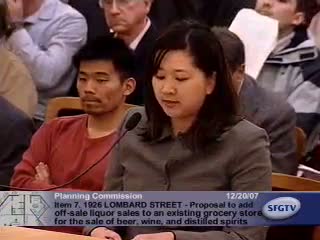
Planning Commission approves liquor‑license transfer to Luigi’s Delicatessen with conditions
Summary
The Planning Commission approved a conditional‑use transfer of an off‑sale ABC Type 21 liquor license to Luigi’s Delicatessen at 1926 Lombard, imposing conditions including a 10 p.m. limit on alcohol sales, corrected signage, and requirements to emphasize deli/grocery operations and a community liaison.
The San Francisco Planning Commission voted to approve a conditional‑use authorization to transfer an off‑sale ABC Type 21 liquor license to Luigi’s Delicatessen at 1926 Lombard Street, subject to neighborhood‑oriented conditions including a restriction that alcohol sales end at 10 p.m.
Planning staff told the commission the proposal is a transfer — not a new liquor store — under Planning Code §186.1(e) and related sections and recommended approval with conditions to address local concerns over crime, graffiti and trash. Sharon Young of the Planning Department said the proposal would add off‑sale liquor to an existing grocery/deli without expanding the building and that staff had received both letters of support and opposition from the neighborhood.
The project sponsor described the business as a small deli and convenience store that cannot operate viably without the transferred liquor license and agreed to conditions in the draft motion, including sidewalk maintenance and a community liaison to address complaints. Commissioners asked staff to require corrected storefront signage and to limit the visibility of liquor sales from the street; the motion approved by the commission directed that groceries and deli operations be emphasized at the storefront and that alcohol be stored away from the entrance when feasible.
“Given the site history and the applicant’s commitments — including an agreed closing hour of 10 p.m. for alcohol sales — staff recommended approval with conditions to minimize neighborhood impacts,” Young said during the presentation.
The commission recorded a roll‑call vote in which a majority voted to approve the transfer with the stated conditions. The decision preserves the existing neighborhood service while placing limits aimed at reducing late‑night impacts.
The applicant may need to comply with any additional state ABC conditions and local business licensing requirements before commencing alcohol sales under the new authorization.