Get Full Government Meeting Transcripts, Videos, & Alerts Forever!
Get email alerts on the Supportive Housing topic
No spam. Unsubscribe anytime.
Board upholds Parcel G supportive‑housing permit, requires 'good neighbor' plan
Summary
After hours of public comment and attorney presentations, the Board of Appeals upheld the Redevelopment Agency's site permit for Parcel G (365 Fulton) to allow a five‑story, 120‑unit supportive housing project but added conditions requiring a neighborhood communications and maintenance plan.
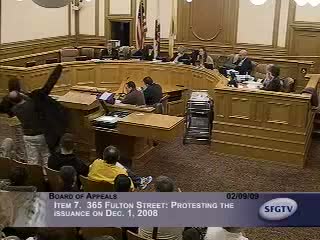
The San Francisco Board of Appeals unanimously upheld a redevelopment agency site permit on Feb. 11 for Parcel G, a proposed five‑story, 115–120‑unit supportive housing building at 365 Fulton Street, after a lengthy hearing that brought dozens of residents and neighborhood representatives to the podium.
Donna Benedetti, representing the Hayes Valley Coalition and appellant Scott Keeling, urged the board to require full compliance with Market Octavia (MO) standards, arguing that the project relied selectively on the expiring Western Addition A2 plan for some provisions while citing MO for others. She pressed the board to review open‑space allotments (she said 9,000 sq. ft. proposed vs. a 12,000 sq. ft. MO minimum), density increases (variance from 92 to 120 studio units), lot size and projection encroachments, and sidewalk impacts that she said could impede people with mobility limitations.
Redevelopment Agency Deputy Executive Director Olson Lee and agency counsel emphasized that the agency owns the parcel, provided entitlements and funding, and had coordinated with the Department of City Planning; they said the project helps implement the mayor’s 10‑year plan to end chronic homelessness and leverages tax credits and state housing funds. Heidi Gourwitz, Deputy General Counsel for the agency, highlighted reasonable‑accommodation obligations under federal, state and local fair‑housing law.
Developers Mercy Housing and Community Housing Partnership described services to be co‑located with housing (case managers, social workers, psychiatric services), retail at ground level and property management practices; Community Housing Partnership said it has a strong record managing similar buildings.
Public comment was extensive and mixed: neighborhood association leaders, longtime residents and some nearby tenants supported the project as needed housing and said the developers had undertaken community outreach; other immediate neighbors raised concerns about notice, potential parking impacts, possible loss of open space and safety at peak times.
During deliberations commissioners asked detailed questions about parking, retail vacancy risks, financing timing and which agencies would later review addenda or signage; Development staff and agency representatives said building permits would be reviewed by DBI and some future discretionary reviews (for conditional use permits, signs) would fall under Planning. President Fung moved to uphold the permit but require a formal "good neighbor" communications and maintenance plan, to be codified in findings to be adopted later. The board voted 5‑0 to uphold the site permit with those conditions.
The decision allows the project to proceed while directing the agency and developers to produce specific neighbor‑oriented commitments on outreach, exterior maintenance and a neighborhood advisory committee.