Get Full Government Meeting Transcripts, Videos, & Alerts Forever!
Get email alerts on the Tobacco Enforcement topic
No spam. Unsubscribe anytime.
Board upholds two DPH tobacco suspensions, reduces one to 12 days
Summary
The San Francisco Board of Appeals upheld one 15-day tobacco‑sales suspension and reduced a second to 12 days after hearing Department of Public Health enforcement cases and testimony from store owners who said sales to decoys were honest mistakes.
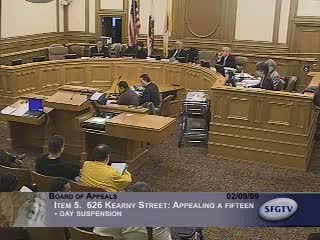
The San Francisco Board of Appeals on Feb. 11 heard appeals from two retail permittees whose stores were cited by the Department of Public Health for selling tobacco to minor decoys and imposed 15‑day permit suspensions.
Dr. Johnson Ojo, representing the Department of Public Health, summarized two police monitoring actions in October 2008 in which 15‑year decoys purchased cigarettes. Under San Francisco Health Code §1009.66, DPH said the agency had the authority to suspend permits for up to 90 days and that a 15‑day suspension was the usual penalty for first offenses; DPH noted that, effective Jan. 1, its minimum suspension policy would increase to 25 days for some cases. "We respectfully ask the board to deny the committee's appeal and suspend the permit for 15 days," Ojo told commissioners.
The permit holders and witnesses described the sales as mistakes. At 626 Kearny Street, owner Hakim Haidarian and a clerk who said he had blurred vision after chemotherapy said the decoy transaction was unintentional and detailed the economic hardship a multi‑day closure would cause. "This is basically putting him out of business for 10 days or 15 days," Haidarian said, noting high rent and that tobacco accounts for most sales. At 2198 Union Street, owner Joe Zaidan, who said he has operated his store for more than two decades, asked for leniency and noted training and in‑store reminders given to employees.
Commissioners weighed the public‑health goal of deterring sales to minors against the economic impact on small, "mom and pop" stores. Several members said they were sympathetic to first‑time offenders and favoured mitigation options, such as nonconsecutive suspension days or shorter suspensions. Commissioner Goh moved to uphold the Department of Public Health action for the second case but reduce the suspension to 12 days; the motion passed 4‑1. In the earlier case, a motion to reduce a 15‑day suspension to 7 days received a 3‑2 roll call but the city charter requires four votes to overturn a departmental action, so the 15‑day suspension remained in place.
The board recorded votes and procedural instructions on how suspensions must be served; commissioners also discussed education and training by the Tobacco Free Project and whether DPH's evolving policy (including longer minimum suspensions) should factor into penalties. The board’s decisions were procedural: the DPH suspensions remain enforceable with the one reduction to 12 days noted above.
Next steps: each permittee takes the board's decision as the final local administrative outcome for these cases; any further relief would require separate action or appeal to another forum.