Get Full Government Meeting Transcripts, Videos, & Alerts Forever!
Get email alerts on the Affordable Housing Overview topic
No spam. Unsubscribe anytime.
Mayor’s Office of Housing outlines scale of San Francisco’s affordability crisis, public housing redevelopment and inclusionary reforms
Summary
The Mayor’s Office of Housing presented an information-only briefing April 5 to the San Francisco Planning Commission detailing affordability gaps across rental and ownership markets, capital shortfalls for public housing, a task-force proposal to redevelop severely distressed sites under Hope SF, and recent reforms to the city’s inclusionary housing rules.
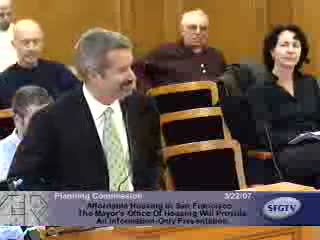
Matt Franklin, director of the Mayor’s Office of Housing, told the Planning Commission April 5 that San Francisco faces acute affordability challenges in both rental and ownership markets and outlined the office’s strategies for preservation, redevelopment and production.
Franklin said the city uses U.S. Department of Housing and Urban Development (HUD) area median income (AMI) bands to set program targets: about 60% AMI for inclusionary rental units and 100% AMI for many ownership units. He described a ‘‘dumbbell’’ income distribution with many households below 50% of AMI and many well above 120% AMI, leaving a relatively small middle.
On rentals, Franklin cited a median rent near $2,000 — roughly the 100% AMI affordability threshold for a three-person illustrative household — while the ownership market’s median home price exceeds $700,000, which he said effectively requires households near 200% AMI to afford median-priced homes under standard underwriting assumptions.
Franklin reviewed HUD cost-burden metrics and said the city counts roughly 65,000 households in HUD’s ‘‘worst case’’ category and about 25,000 in the ‘‘severe’’ category (households earning under 50% AMI and paying more than 50% of income for housing). He emphasized that many of the lowest-income households are smaller (one- or two-person households) but that significant numbers of families also need deeply affordable units.
On public housing, Franklin said the San Francisco Housing Authority has about 6,100 public housing units across roughly 52 developments, with a concentration of family units in the southeast part of the city (about 2,500 units) and roughly 40% of the portfolio designated for seniors. He said an independent capital-needs review classified about 2,500 units on eight sites as so distressed they should be redeveloped and estimated the total capital shortfall at about $275 million and deterioration worsening at roughly $26 million per year.
Because many public housing sites are low-density yet located on valuable land, Franklin described a task-force recommendation to pursue mixed-income, higher-density redevelopment that replaces every public housing unit (one-for-one replacement) while adding market-rate units to cross-subsidize reconstruction. He said HUD and the federal ownership of some sites would make HUD a necessary partner and that the mayor’s office and the redevelopment agency would aim to preserve the public housing priority while also producing additional affordable units on-site or nearby.
Franklin and his team reviewed the Mayor’s Office of Housing’s financing approach: the city typically provides 30%–50% of initial development costs for projects it funds and then leverages Low-Income Housing Tax Credits, state programs (notably Prop. 46 and Prop. 1C funds) and other public financing; the office typically records use restrictions on deeds for 55-year periods and treats those commitments as effectively perpetual.
On the inclusionary housing program, the presentation summarized current rules and recent reforms: projects over four units must comply with a 15% on-site option, 20% off-site option, or a 20% in-lieu fee; the city has centralized waitlists and instituted mandatory lotteries for both new units and resales, strengthened marketing and outreach (including language access), implemented asset and occupancy tests, and moved to update in-lieu fees annually (next scheduled update July 1).
Franklin also previewed area-plan work (Bayview, Transbay, Treasure Island, Mission Bay, Hunters Point) and flagged Eastern neighborhoods as a priority area where planning staff, the mayor’s office and economic development are coordinating new analytical tools — including land-value and feasibility analysis, density bonuses and land-dedication approaches — to identify how much additional affordable and market-rate housing could be created.
He framed the chief constraints as funding (federal capital sources have largely dried up; Hope VI/HUD funding levels have fallen) and site availability, while noting the Mayor’s Office of Housing baseline capital budget had increased roughly 40% over the prior two years but that aligning financing each year remains difficult. Franklin said the city expects to provide initial funding averaging about 710 affordable units per year over a three-year period and that projected inclusionary production in 2007 was roughly 350 units; historically the city’s completion run rate has been nearer 450 affordable units annually.
The presentation was information-only; no formal actions were taken. Franklin and staff fielded commissioner questions on voucher counts, household sizes, senior definitions, HUD regulatory authority and policy trade-offs between serving the lowest-income households and moderate-income or middle-class needs.
Ending: Franklin said staff will continue working with planning department analysts and return with site-specific studies and that public engagement and resident involvement will be central to any redevelopment planning.