Get Full Government Meeting Transcripts, Videos, & Alerts Forever!
Get email alerts on the Landuse Pdr Rezoning Bayview topic
No spam. Unsubscribe anytime.
Planning Commission adopts PDR zoning for Bayview to preserve industrial jobs amid neighborhood debate
Summary
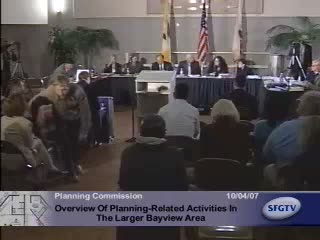
The Planning Commission voted to adopt text and map amendments establishing PDR 1 and PDR 2 zoning in Bayview Hunters Point (Case No. 2006.0074), intended to preserve light industrial space and buffer residential areas. The vote followed hours of public testimony from residents, business owners and community leaders, with arguments both for job preservation and against rezoning impacts on Third Street and open‑space edges.
The San Francisco Planning Commission adopted text and map amendments to create two Production/Distribution/Repair (PDR) zones in Bayview Hunters Point (Case No. 2006.0074), a move staff and supporters said will protect roughly the current light industrial land base and the estimated 15,000 jobs it supports while opponents warned the change could affect Third Street commerce, open‑space buffers and residents’ long‑term affordability.
Planning staff described the proposal as the implementation of the Bayview Hunters Point area plan: replace older M‑1/M‑2 industrial districts with PDR 1 and PDR 2 to preserve job‑intensive uses, limit large offices and restrict certain heavier industrial operations, and create buffer mechanisms along residential edges. John Lau (formerly the planning department’s Bayview lead, now legislative aide to Supervisor Sophie Maxwell) and Supervisor Maxwell stressed preserving job diversity and balancing housing and employment opportunities so residents have local work options.
Fred Blackwell, the redevelopment agency’s new executive director, told commissioners the agency’s priorities include avoiding past redevelopment mistakes, committing tax‑increment funds to affordable housing and partnering with planning to ensure local hiring and job training. Redevelopment and Planning staff emphasized a delegation agreement making the Planning Department the primary entitlements authority while the agency provides funding and programs.
Public testimony split along predictable lines. Business owners, property managers and industrial users urged adoption to provide certainty and prevent ad‑hoc parcel conversions that would push PDR uses out of the city. ‘‘Please end this uncertainty for at least one segment of the Eastern neighborhoods and pass these items in an unaltered manner,’’ read a statement on behalf of local industrial property owners.
Long‑time Bayview residents, community leaders and some neighborhood activists urged the commission to pause or modify parts of the rezoning. Espanola Jackson testified she opposed any remapping of her community and urged more time for study of housing affordability and open‑space buffers; Reverend Arnold Townsend and others said placing PDR on parts of Third Street could create commercial gaps that harm neighborhood retail activity.
Commissioners discussed specific edge parcels (notably near Yosemite Slough), the need to preserve creek/open‑space buffers and workforce development connections. Several commissioners said they supported the zoning package while urging future follow‑up on Third Street commercial continuity, creek buffers and workforce training/monitoring. A motion to adopt both the zoning text and map amendments passed with an affirmative vote recorded by commissioners present; staff will finalize resolutions for the text and map amendments.
What the action does: the PDR designations narrow allowed competing land uses (housing and large office) in targeted areas, provide buffering rules at industrial edges, and aim to stabilize job‑bearing parcels so existing light industrial firms have room to continue and expand. The adoption does not itself change individual entitlements, which will still come back to the Planning Commission under the delegation agreement; it changes the zoning rules that will guide future permit decisions.
What happens next: the Planning Department will finalize the map and text amendment resolutions and forward them for any required next steps. The redevelopment agency and other city offices plan to continue coordinating on workforce, affordable housing and historic‑preservation work to accompany the rezoning.