Get Full Government Meeting Transcripts, Videos, & Alerts Forever!
Get email alerts on the Infrastructure Crystal Springs Tunnel topic
No spam. Unsubscribe anytime.
Residents press planning commission on Crystal Springs tunnel EIR, citing noise, health and viable alternatives
Summary
At a Planning Commission hearing, San Mateo residents, homeowner associations and regional water buyers raised health, noise, vibration and alternative‑route concerns about the San Francisco Public Utilities Commission’s draft EIR for the Crystal Springs Bypass Tunnel (Case No. 2003.0655E). The PUC defended the tunnel as necessary to protect seismic reliability; the comment period closes Oct. 9, 2007.
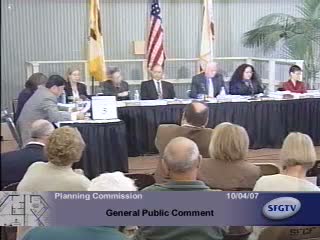
The San Francisco Planning Commission held a hearing to receive public comments on the draft environmental impact report for the San Francisco Public Utilities Commission’s new Crystal Springs Bypass Tunnel Project (Case No. 2003.0655E), with technical staff presenting the PUC’s justification and members of the San Mateo community criticizing the EIR’s noise, health and vibration analyses.
PUC project manager Tassal Mabridis told the commission the project is intended to reduce the risk of pipeline failure during a major seismic event and to maintain post‑quake service. “We are obligated to deliver about a 120,000,000 gallons to the Peninsula and San Francisco within 24 hours of a major seismic event,” Mabridis said, describing a bored tunnel roughly 4,200 feet long and shafts 60–200 feet deep as the option that best meets the project objectives. The PUC’s presentation described alternatives studied in the DEIR and explained the agency’s selection of a deep bored tunnel to avoid ground‑surface movement and landslide vulnerability to the existing prestressed concrete cylinder pipe.
Residents and representatives from the San Mateo Oaks Homeowners Association and nearby neighborhoods urged the commission to scrutinize the report’s assessment of nighttime tunneling, blasting and muck disposal and to consider a different alignment or a shallow‑pipeline alternative. Dave Byers, representing the San Mateo Oaks HOA and an attorney, said the draft EIR itself indicates Alternative 2 (a full‑capacity shallow pipeline) would “reduce or avoid significant impacts associated with noise, nighttime light and glare, and air quality in the South Shaft area” and asked the commission to give that option more weight. “This alternative would likely reduce noise to less than significant levels because no shaft excavation or tunneling operation would occur, including no nighttime work,” Byers said.
Other commenters described health worries from dust and particulates during the construction period and questioned whether the draft EIR located acoustic receptors appropriately for the natural bowl topography in the South Shaft area. Norma Bozzini, a retired physician, testified she was “very concerned about the health impacts” and argued that noise and particulate exposure would affect many more homes than the DEIR suggests.
PUC staff answered a series of technical questions from commissioners about why this segment of a roughly 185‑mile regional system was prioritized, why the agency selected a deep bored tunnel instead of trenching or replacing the pipe in place, and why the project schedule includes 24‑hour tunneling shifts. The PUC said the pipeline at the Pulgas/Crystal Springs alignment is highly susceptible to landslide and seismic movement (PUC modeling cited possible lateral ground movement of up to 20 feet in some scenarios), making conventional pipe replacement vulnerable to catastrophic failure. Staff acknowledged the 36‑month construction estimate was conservative and based on worst‑case staging and permitting assumptions.
Nicole Sankula of the Bay Area Water Supply and Conservation Agency, representing 27 wholesale water purchasers, urged the commission to certify the adequacy of the EIR so the PUC can move forward expeditiously, stressing the tunnel’s role in regional post‑quake water delivery to hospitals, the airport and large customer areas.
The hearing was limited to comments on the adequacy and completeness of the draft EIR; the PUC noted that responses to comments will appear in a comments‑and‑responses document to be prepared for the final EIR in early 2008. Commissioners indicated they may follow up with additional technical hearings and that the commission’s role is to assess the environmental review rather than approve the project itself. The public comment period for the draft EIR was announced as ending at 5 p.m. on Tuesday, Oct. 9, 2007.
What happens next: the commission’s transcripted comments will be included in the administrative record; the PUC will publish the responses to comments in the final EIR. The Planning Commission did not vote on project approval at the hearing; the PUC will retain project approval authority following certification of the final EIR.