Get Full Government Meeting Transcripts, Videos, & Alerts Forever!
Get email alerts on the Inclusionary Housing topic
No spam. Unsubscribe anytime.
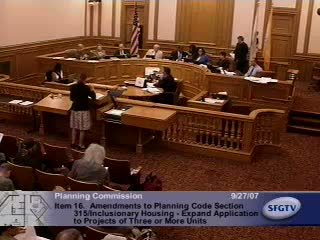
Commission split on expanding inclusionary housing to three-unit projects; small builders warn of production impacts
Summary
Planning staff recommended adding 3‑ and 4‑unit projects to San Francisco’s inclusionary program (10% requirement); staff estimated modest revenue, but small builders and commissioners warned the proposal could discourage small-scale housing production. The Commission took no formal recommendation and sent the ordinance forward for further review.
San Francisco — Planning staff outlined a proposal to extend San Francisco’s inclusionary affordable‑housing requirement to projects of three or more units, introducing a 10 percent obligation for three‑ and four‑unit buildings and an in‑lieu fee option.
Sue Eckstein of the Planning Department described staff and controller analyses showing the new fees would raise modest revenue (staff estimated about $15 million over five years under one scenario) but also flagged risks that builders might reduce project size to avoid the fee. “Our analysis indicates the program provides valuable revenue for affordable housing but there are limited concerns about feasibility and potential downsizing,” Eckstein said.
Many small builders and local contractors testified in opposition, calling the change a de facto tax on small housing production and warning it could push projects out of the city. “This is a tax on housing production,” said Jerry Agusta, a small builder, who said the proposed fees would make many small projects uneconomic.
Commissioners debated alternatives, including a modest flat fee applied to all residential permits rather than a percentage‑based requirement for small projects. After extended public testimony and commissioner discussion, the Commission did not take a recommendation (the motion put the item before the Board without a formal approval recommendation), leaving further choices to the Board of Supervisors.
What’s next: The matter will proceed to the Board of Supervisors with the Planning Commission’s discussion and the public record; commissioners asked staff to explore alternative fee structures and to provide additional feasibility analysis.