Get Full Government Meeting Transcripts, Videos, & Alerts Forever!
Get email alerts on the Business Permits topic
No spam. Unsubscribe anytime.
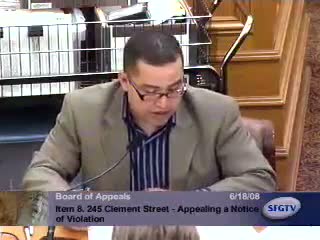
Board sides with permit holder on Clement Street massage use, orders planning to negotiate enforceable conditions
Summary
The Board of Appeals overruled a notice of violation against Johnson Yu’s acupuncture/massage operation on Clement Street, citing the permit holder’s reliance on a police department permit and directing Planning staff to negotiate enforceable accessory‑use conditions; formal findings to follow.
The San Francisco Board of Appeals on June 18 overruled a planning department notice of violation that said a massage use on the Second Floor of 442 Clement Street was not an allowed independent use. Planning had maintained the massage use had to be accessory to a medical office, limited to 300 square feet and to two massage therapists.
Attorney Bridal Gladstone, representing Dr. Johnson Yu, told the board the owner relied on a police department permit and spent roughly $70,000 to build out therapy rooms. "The application was to build out the massage because the patients requested both acupuncture and massage under the same roof," Gladstone said. The permit holder said he did not receive the specific planning conditions that Planning later said applied.
Planning senior planner Tina Tam said the department’s file contains a referral noting accessory‑use limitations and that the plans submitted to the police department included references to medical office use; she urged the board to uphold the notice of violation. "The planning department approved a medical office use at this location; they did not approve three separate businesses," Tam said in part.
After hearing testimony from both sides, members of the board expressed sympathy for the permit holder’s claimed reliance on the police permit but stressed that any relief should be balanced with enforceable safeguards for the neighborhood. Vice President Frank Fung moved to overrule the notice of violation and asked Planning and the permit holder to negotiate a set of conditions that emulate accessory‑use protections (access via the principal medical entrance, signage and hour restrictions, and other limits) and return findings and conditions to the board. The motion passed 4–0.
The board did not adopt final conditions at the hearing. Planning staff said they would continue work with the permit holder to craft conditions that protect neighborhood character while recognizing the permit holder’s investment and the regulatory constraints that led him to rely on a police permit.