Get Full Government Meeting Transcripts, Videos, & Alerts Forever!
Get email alerts on the Taxi Medallion Revocation topic
No spam. Unsubscribe anytime.
Board continues contested medallion revocation for Robert Michael Friedman to July 23 amid debate over safety and rehabilitation
Summary
After hearing testimony about multiple DUI convictions, concealment of prior offenses and months of advocacy from colleagues and community members, the San Francisco Board of Appeals continued the appeal of Robert Michael Friedman’s medallion revocation to July 23 to allow parties to draft conditional suspension terms and evidence.
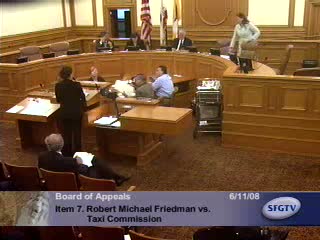
The San Francisco Board of Appeals on a packed docket continued the appeal over the Taxi Commission’s decision to revoke Robert Michael Friedman’s taxi medallion until July 23, after a daylong hearing that laid out sharply conflicting accounts of public-safety risk and the driver’s rehabilitation.
The Commission’s staff urged revocation, saying Friedman had multiple DUI convictions that were not disclosed on required annual forms and that the totality of circumstances created a threat to public safety and to the integrity of the city’s taxi program. Acting Taxi Commission director Jordana Thigpen told the Board the medallion “should be revoked and released to someone who is on the waiting list,” saying the respondent “continues to collect income on this permit” while delays continue.
Sergeant Ron Reynolds of the SFPD Taxi Detail described his investigation and told commissioners his review identified four DUI convictions and noted relapse risk; he said the agency’s inquiry found evidence of arrests and convictions across counties that the Commission had to assemble by contacting courts and police departments.
Defense attorney Jeffrey Roetwein challenged the Commission’s reliance on evidence not clearly timely introduced and warned the Board it should protect due process rights. Robert Michael Friedman, who testified on his own behalf, described a decades-long taxi career, recent treatment and meetings in recovery, and said he had been sober for "two years and six months". He asked for an opportunity to continue working and to participate in supervision or treatment.
Members of the public, including other medallion holders and cab industry representatives, were split: several urged mercy and cited Friedman's recovery and long record of safe driving; owners and managers of cab companies and several drivers said they would not allow him behind the wheel and raised safety and fairness concerns for waiting-list applicants.
Board members debated remedies including outright revocation, suspension tied to regular testing and reporting, preserving income for the medallion holder while prohibiting him from driving, and whether the Commission could impose progressive discipline given alleged concealment of convictions. Commissioners asked staff whether ADA accommodations exist that can allow a medallion holder to retain income while not driving; staff said some ADA accommodations have been used for non-driving periods but that alcoholism-specific accommodations had not been previously granted in that way.
Because the parties and commissioners asked for more time to craft a specific conditional-suspension proposal (length, testing frequency, reporting and enforcement), the Board voted to continue the matter to July 23. The continuance was framed to allow the two sides to return with mutually proposed conditions, evidence and declarations the Board can use when it next considers whether to uphold or modify the Taxi Commission's revocation order.
The Board’s action leaves the underlying Commission decision in place pending the July hearing. The continuance drew a unanimous vote among the four seated members (Commissioner Holland was absent).