Get Full Government Meeting Transcripts, Videos, & Alerts Forever!
Get email alerts on the Land Use Permits topic
No spam. Unsubscribe anytime.
Board of Appeals revokes Culinary Arts Studio permit after residents raise noise, odor and safety concerns
Summary
After hours of testimony from Museum Park residents and technical rebuttals from the permit holder, the San Francisco Board of Appeals voted 4–0 to revoke the permit for Culinary Arts Studio & Cafe at 725 Folsom, citing unresolved concerns about noise, vibration, heat and exhaust controls; formal findings will be adopted later.
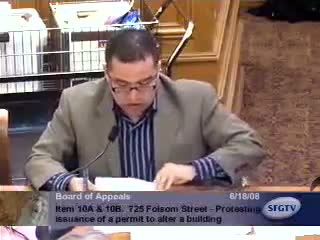
The San Francisco Board of Appeals voted unanimously on June 18 to revoke the building permit for Culinary Arts Studio & Cafe at 725 Folsom Street after residents and the homeowners association described persistent risks to life‑safety, noise, odor and vibration in the residential building above the proposed commercial kitchen.
Museum Park residents and their representatives told the board that the planned production kitchen — described in filings as a space with up to six rentable kitchen stations and a 36‑burner capacity — would create persistent noise, heat and smells that would intrude into the 235 apartments above. "This is a diesel engine in a Volkswagen; it's the wrong place," said Scott Lane, president of the Museum Park HOA compliance committee. Resident Carol Ginn said the vent would run five feet from her balcony and "I won't have songbirds, and I won't have a place to stand."
Culinary Arts Studio owner Christopher Pastina and his team said they had hired an acoustical engineer and an architect and installed multiple mitigation measures, including large silencers, vibration isolation springs and an electrostatic precipitator to clean exhaust. "We have met all requirements and have been approved by the building department and the San Francisco Redevelopment Agency," Pastina said, adding the business intended to be an incubator for other local food enterprises. Acoustical consultant Randy Waldock of Charles Salter Associates said long‑term ambient measurements and recommended isolation measures put predicted noise at or below existing traffic and rooftop equipment levels.
Lawrence Kornfield, the city’s chief building inspector, told the board that DBI had required specific equipment and installation details to reduce vibration and noise. He said the department could not guarantee there would be no problems, but that the permit drawings and maintenance plan substantially raised the technical standard. "We cannot absolutely with certainty guarantee that there won't be problems with noise or smell or vibration," Kornfield said, but recommended rigorous inspection and an included maintenance schedule.
After public comment, rebuttals and board deliberations focused on the adequacy of monitoring and enforceability over time, Vice President Frank Fung moved to revoke the permit on the grounds identified in the appellants' case and DBI staff analysis. Commissioners Kendall Goh, Michael Garcia and Tanya Peterson voted Aye on the motion; the revocation passed 4–0. The board directed staff to prepare formal findings for later adoption.
The board's action does not itself bar the permit holder from returning with revised plans or additional evidence; the record shows the board intends to formalize its reasoning in written findings that will be posted later. The board also discussed interim safety checks during continuances in other matters, noting DBI and the Fire Marshal had been asked to monitor any immediate life‑safety concerns.