Get Full Government Meeting Transcripts, Videos, & Alerts Forever!
Get email alerts on the Academy Enforcement topic
No spam. Unsubscribe anytime.
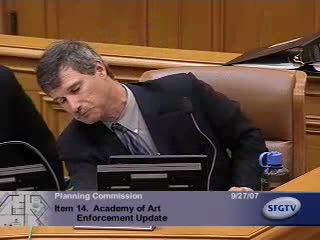
Planning commission presses Academy of Art on code violations; neighborhood groups call for institutional master plan
Summary
Planning staff outlined a months‑long enforcement effort into the Academy of Art University, which owns more than 30 properties in San Francisco; commissioners and neighbors urged a comprehensive institutional master plan and clearer enforcement steps. The commission heard arguments both for cooperation and for stronger penalties.
San Francisco — The Planning Commission on Thursday directed staff to continue enforcement oversight of the Academy of Art University after a lengthy presentation and an extended public-comment period in which neighbors, union leaders and the school’s supporters sharply disagreed about the institute’s conduct.
Scott Sanchez of the Planning Department told commissioners that code-enforcement work began in mid‑2006 and that the department issued a notice of violation requiring an institutional master plan (IMP). Sanchez said the Academy later submitted an IMP and subsequent documentation, and that staff identified dozens of properties and multiple alleged violations related to signs, use permits and conversions.
“Shortly after the issuance of the notice of violation, the Academy of Art University submitted an IMP,” Sanchez said, describing staff’s review and the department’s concern that some properties had been converted or occupied without required permits.
Neighbors and community groups told the commission they had received little notice of acquisitions and conversions, and they urged stricter enforcement. “We want the public to have the right to look at plans and to be heard,” Patricia Boyd said, arguing that reduced, illegible drawings and inconsistent notices denied due process to immediate neighbors.
Supporters, including representatives of the Firefighters and Police Officers associations and a series of current and former Academy staff, said the school contributes jobs, educational opportunities and neighborhood investment. “The Academy has provided thousands of educational opportunities,” Gary Delagnes of the police association told the commission.
Commissioners coalesced around two priorities: (1) require the Academy to complete and clarify its institutional master plan with broader neighborhood notice; and (2) continue to press code-enforcement remedies for individual properties that remain out of compliance. Several commissioners said the commission lacked the municipal tools to levy large monetary penalties under the current code but asked staff to report back on enforcement options, including injunctions and code amendments.
Deputy City Attorney Marlena Byrne told commissioners the office would provide legal guidance on enforcement tools and on how a sunset or other legislative language could be drafted if the Board of Supervisors seeks changes.
The commission did not vote to impose new penalties at Thursday’s meeting. Commissioners and staff asked the Academy’s legal team to work with code enforcement on a prioritized schedule to address the most serious properties first, and to bring a clear timeline and a public‑notice plan for the IMP to a future meeting.
What’s next: Staff will report back with an enforcement timetable, legal options for stronger penalties, and a recommended schedule for a public hearing on the institutional master plan. The commission asked the Academy to provide a named contact for neighborhood inquiries and monthly status updates to staff.
(Reporting in this item relied on the Planning Department’s presentation and on public testimony and statements made in commission remarks.)