Get Full Government Meeting Transcripts, Videos, & Alerts Forever!
Get email alerts on the Medical Cannabis topic
No spam. Unsubscribe anytime.
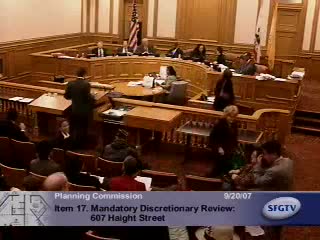
Planning Commission approves discretionary review for Vapor Room relocation with conditions
Summary
After a lengthy hearing on accessibility, ventilation, noise and neighborhood impacts, the Planning Commission granted discretionary review and approved the Vapor Room’s relocation (607 Haight) with conditions including strong discouragement of driving after on‑site medication and soundproofing requirements.
The Planning Commission voted Sept. 20 to take discretionary review of, and approve with additional conditions, a proposed medical cannabis dispensary and vapor room at 607 Haight Street. The project sponsor proposed to relocate an existing vapor room to a neighboring storefront that is properly zoned for the use; the hearing focused on ventilation, accessibility for disabled patients, on‑site consumption and neighborhood impacts.
Architect Leslie Young described the proposed tenant improvements, ventilation scheme and accessibility modifications; Nicole Strand of the Vapor Room and management staff detailed community outreach, a proposed code of conduct for members, and security and filtration systems. Security consultant Richard Karnes (retired SFPD captain) presented a security plan that included cameras, trained staff and no‑loitering policies.
Neighbors raised concerns about odor, noise, visible queuing on stoops, safety and the potential for patients to leave the site after on‑site consumption and drive. Speakers described previous neighborhood conflicts at the existing location and asked that on‑site consumption be prohibited or strictly controlled. Supporters—patients, community groups and nonprofit advocates—testified that the facility offers essential medicine and community services, that it provides access for homebound or disabled patients, and that the sponsor has implemented community outreach and compassion‑medicine programs.
After deliberation the commission voted to take discretionary review and approved operation with required mitigations: a written code of conduct and intake procedures prohibiting or strongly discouraging driving after medicating; rooftop sound‑attenuation measures; a ventilation plan routing emissions away from the sidewalk and into rooftop mechanical exhaust as shown in the applicant’s submittal; interior intake to minimize outside queuing; and enforceable security and no‑loitering policies. The approval included the condition that the commission may revisit compliance if neighbors continue to raise validated concerns.