Get Full Government Meeting Transcripts, Videos, & Alerts Forever!
Get email alerts on the Zoning Rezoning topic
No spam. Unsubscribe anytime.
Planning Commission reviews Eastern Neighborhoods rezoning, inclusionary proposals and PDR protections
Summary
Planning staff presented a comprehensive rezoning for the Eastern Neighborhoods that would create new residential and mixed‑use districts, protect key PDR (production, distribution, repair) areas and apply additional inclusionary housing rules to upzoned parcels; the package drew extensive public comment on heights, feasibility and open‑space commitments.
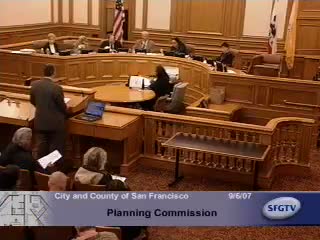
Planning Department staff presented a detailed rezoning proposal for the Eastern Neighborhoods at a special San Francisco Planning Commission meeting Sept. 6, 2007, outlining new residential, PDR and mixed‑use districts alongside proposed affordable‑housing requirements and parking and bedroom‑mix controls. Ken Rich, senior planning staff, told the commission the presentation would cover zoning, proposed heights and urban‑design policies and follow a schedule that aims to release draft area plans in October and bring formal actions to the commission in December and January.
The staff proposal retains a substantial portion of the city’s industrially zoned land as PDR while allowing other parcels to convert to mixed use. Rich said the department’s analysis began from roughly 1,900 acres of industrially zoned land and that option B of staff’s framework would retain about 1,500 acres of PDR while allowing housing and mixed uses on the remainder. Jennifer Matz of the Mayor’s Office of Economic and Workforce Development told the commission that PDR businesses “provide good jobs, that average above average salaries at every education level,” and that the mayor’s office is pursuing targeted retention and outreach through an industrial retention manager.
Key proposed controls
Staff proposed replacing residential density maximums with height and bulk controls combined with a bedroom‑mix requirement (staff proposed 40 percent two‑bedroom units and 10 percent three‑bedrooms encouraged). Parking controls vary by transit intensity: in the most transit‑served areas the proposal would mirror existing C‑3 capping (a by‑right maximum of 0.25 spaces per unit with conditional increases), while in less transit‑oriented areas the by‑right ratios would be higher (for example, 0.75 spaces per one‑bedroom unit). For nonresidential uses, staff proposed easing some current office parking requirements and limiting large retail in certain mixed‑use districts so that retail over 25,000 square feet would require housing above it.
PDR districts and allowed uses
Planning staff described multiple PDR district types (PDR2, PDR1, a PDR‑design district and Central Waterfront M2 retainment). The PDR zones are intended to protect production, small manufacturing, arts and multimedia uses while allowing compatible small offices and institutional uses; staff explained that large office uses (over 5,000 square feet) and large retail (over 2,500 square feet) would be constrained in many PDR districts. Staff also noted current citywide PDR vacancy in 2007 was low — roughly 2–4 percent — and said that factor informed the approach to preserving key industrial land.
Affordable and mixed‑income rules
For districts where housing would be permitted, staff retained the city’s base inclusionary requirement (15 or 20 percent) and proposed additional inclusionary obligations where development potential is increased through upzoning (an additional fee or other mixed‑income options would apply where upzoning occurs). In the Urban Mixed Use (UMU) zones — former industrial parcels rezoned for mixed use with housing — staff proposed a menu of options intended to produce a range of below‑market units: 100 percent affordable projects, land‑dedication options for larger sites, and a moderate‑income option capped at roughly 140–150 percent of area median income (staff clarified the moderate option would top out at 140–150% AMI, not 200%).
Legal nonconforming and transitional measures
To address existing uses that would become nonconforming under the new zoning, staff proposed flexible rules: existing residential in PDR districts where residential would no longer be allowed could remain indefinitely but could not add additional units; larger office or retail uses with a permit history would continue as legal nonconforming uses and could be occupied interchangeably so long as total nonconforming space in a building did not increase.
Public reaction and next steps
The presentation drew extensive public comment. Speakers objected to aspects of the proposed heights and to the perceived feasibility of high inclusionary set‑asides (several developers, property owners and trade groups said a 50 percent land‑dedication or similar requirement would render some projects infeasible). Other commenters urged stronger protections for neighborhood character, ground‑floor retail, parks and live‑work residential uses in areas currently used as housing.
Commissioners asked staff for more granular financial feasibility and pipeline information before finalizing the public‑benefits package. Staff committed to provide a memo with unit counts in the development pipeline, a breakdown of which projects are code‑compliant and further feasibility analysis tied to the nexus study for fees and conditions. The department indicated it expects to return to the commission in October with draft area plans and additional analysis.
What happens next
Staff will publish draft area plans and follow up with numerical feasibility work and a nexus study to justify any upzoning‑linked fees. The commission directed staff to provide the requested pipeline and feasibility memo in the next packet so commissioners can decide whether to reopen springing‑conditions or fee decisions.