Get Full Government Meeting Transcripts, Videos, & Alerts Forever!
Get email alerts on the Land Use Armory Kinkcom topic
No spam. Unsubscribe anytime.
San Francisco planning hearing erupts over kink.com's use of historic Mission Armory
Summary
At a March 8, 2007 Planning Commission special hearing, the zoning administrator said a Jan. 4 letter of determination found film production a permitted use for the 1800 Mission Street Armory; a lengthy public comment period split neighborhood groups between supporters who praised building rehabilitation and opponents who decried notice, alleged social harms and asked for conditional review.
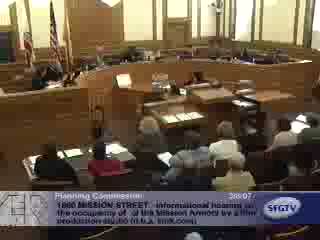
A special March 8, 2007 public hearing of the San Francisco Planning Commission drew a packed room and sharply divided public comment over the use of the historic Mission Armory at 1800 Mission Street after its purchase by kink.com.
Lawrence Badner, the city's zoning administrator, told the commission that he issued a letter of determination on Jan. 4 concluding that film production is an arts activity and a permitted use in the site's commercial/industrial zoning. "A film studio is considered an arts activity. It is a permitted use," Badner said, explaining that the planning code makes no content-based distinction and that a letter of determination answers whether a use is allowed under the code rather than judging appropriateness.
Why the hearing matters: the neighborhood's residents and community organizations said they were not given notice of the sale and the change of occupant and asked whether the city should require conditional use review, seismic and ADA upgrades, or other permitting tied to substantial renovation. Opponents pressed the commission to consider the Armory's proximity to community facilities and shelters and to reassess whether the current use should have triggered additional review. Supporters, including current and former Mission residents, kink.com employees and representatives of local cultural events, said the company has cleaned a long-vacant, blighted landmark, created local jobs, and will make the Armory functional again.
Voices from the hearing: opponents framed the issue as one of process and social impact. "We were never informed of the sale," said Aurora Grajeda, representing long-term neighborhood involvement, and community groups asked that the commission "void the letter of determination" or require a conditional use permit before expansion. Roberto Soriano said he was "completely opposed" to the Armory being occupied by kink.com and called the company's video content "glorification of torture," urging city action given the Armory's proximity to Casa de las Madres, a battered-women's shelter.
Supporters emphasized preservation, jobs and civil liberties. "They're taking an unoccupied building that had no security ... they're going to clean up the area," Jo Hennigan said. Peter Ackworth's supporters and representatives of Folsom Street Events noted donations to local charities and argued the firm would be a good neighbor. Michael O'Rourke, speaking as a screen actor, said the facility could bring film work back to San Francisco.
Procedure, code and limits of authority: Commissioners and staff repeatedly distinguished between a change of physical use, which can trigger building, seismic and environmental review, and the presence of a permitted activity that does not by itself require notice. Badner said many permits and environmental review processes are triggered only by physical alterations or a formal change of use; he told the commission he received a request from Armory Studios LLC on Nov. 21 and responded on Jan. 4 about whether film production was permitted. Commissioners asked staff to provide answers on seismic and code compliance and about whether any renovation plans submitted would trigger additional permitting.
Next steps: Commissioners acknowledged the community's concerns and the complexity of land-use versus free-speech issues. Several commissioners suggested follow-up briefings or additional hearings as the Eastern Neighborhoods rezoning process proceeds to address neighborhood-wide concerns. The hearing closed with the commission noting there will be other opportunities to consider the site as the city evaluates broader zoning and neighborhood plans.
Authorities referenced in the hearing include a Jan. 4 letter of determination from the zoning administrator and citations to planning-code sections that distinguish "adult entertainment" land-use limitations from a film-production use. The commission did not vote or take formal regulatory action at the March 8 hearing.
The Planning Commission adjourned the special hearing; commissioners said staff will provide further information on seismic, building and notice questions and the Eastern Neighborhoods rezoning will offer additional public input opportunities.