Get Full Government Meeting Transcripts, Videos, & Alerts Forever!
Get email alerts on the Coordination Permit Tracking topic
No spam. Unsubscribe anytime.
San Francisco planning and building staff pledge tighter coordination on permits, tracking and enforcement
Summary
At a Dec. 7 joint hearing, the Planning Commission and Building Inspection Commission reviewed steps to reduce permit delays, improve cross‑department training and build an integrated permit-tracking system; public commenters urged better transparency, unified notices and quicker remedies for stalled projects.
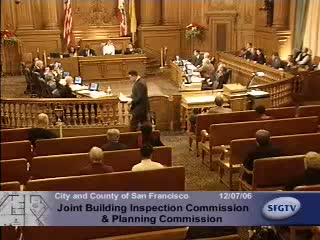
San Francisco’s Planning Commission and Building Inspection Commission met in a joint hearing Dec. 7 to address long-standing gaps between the two departments that residents and design professionals say delay building projects and complicate enforcement.
Department of Building Inspection Director Amy Lee and Planning Department zoning administrator Larry Badner told commissioners they have increased executive-level coordination, are revamping permit‑tracking databases and are working toward a single, integrated customer interface. Badner said planning and DBI see the same projects at different points: “Planning department creates the criteria for building, and then the building department implements,” and both must “understand each other’s definition and role.”
DBI Deputy Director Carla Johnson recommended practical changes to reduce confusion in the field, including requiring that conditions of approval be reproduced on the front page of plan sets so field inspectors see them, and training planners and inspectors together on common issues such as building height and historic‑facade restoration. Johnson also described DBI’s approach to renewals and extensions: if work has started (inspection history is present), renewals are routed routinely; if not, the renewal is routed through the full review again.
Public commenters gave multiple examples of the friction the departments’ staff described. Fire Marshal Barb Shultz urged that the fire department be included early in reviews because it enforces both the building and fire codes. Architect Joseph Whaler and project‑sponsor advocates asked for earlier, lighter touch planning input on projects that are unlikely to be historic, to avoid lengthy and expensive review processes; several speakers described an applicant experience of moving repeatedly between planning and DBI without finality. Resident Crystal Lee testified she has spent years and significant expense trying to secure permits and said the process had become adversarial in her case.
Commissioners pressed staff for practical milestones: improved public-facing permit tracking (including address lookup reliability), consistent retention of neighbor‑notification records (3‑11/3‑12 notices), and clarification of how serial permitting — multiple small permits that together amount to a larger alteration — should be handled. Planning staff said 3‑11 notices are currently retained for two years and will be kept three years after the move to 1650 Mission Street, and DBI said its permanent coordination division will perform quality control on multi‑agency projects.
What’s next: commissioners asked department leaders to continue the joint task force work, report short‑term interim fixes while the full computer integration proceeds, and bring back progress reports at subsequent joint meetings.