Get Full Government Meeting Transcripts, Videos, & Alerts Forever!
Get email alerts on the Commercial Development topic
No spam. Unsubscribe anytime.
Commission splits on Union Street Crunch gym; vote fails and item continued to mid-November
Summary
The commission heard a conditional-use application for a Crunch gym at 1723 Union Street. After business-owners testified that a large gym would threaten small boutiques and debate over neighborhood need, an approval motion failed 3–2; commissioners voted to continue the item to Nov. 16 for further consideration.
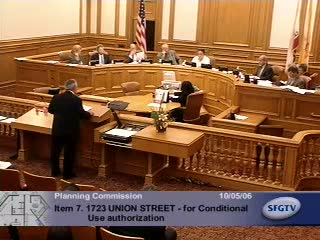
The Planning Commission on Oct. 5 debated a conditional-use permit for a proposed Crunch fitness center at 1723 Union Street, a vacant storefront the sponsor said it would renovate without altering the building exterior.
Staff described the proposal as a full-service gym with cardiovascular equipment, free weights, a spin room and locker/shower facilities. Joel Yodowitz, representing the sponsor, said Crunch would preserve the storefront and rely on a one-half-mile walk market, noting no on-site parking was proposed or required.
Local small-business owners told the commission the new Crunch would undercut neighborhood boutiques. "Opening up a mega branded gym that's over 11,000 square feet will not only severely affect the neighborhood and its businesses, but the parking will be an issue," said Darren Press, a co‑owner of Mercury Fitness, who asked the commission to protect small, locally owned studios.
Commission debate centered on the conditional-use standard that a development be "necessary or desirable." Commissioners split on whether that threshold was met. On the first roll-call after discussion, the motion to approve failed, recorded as 3 in favor and 2 against (Commissioners Moore and Seguaya voting no). The commission then voted 4–1 to continue the item to Nov. 16 to allow additional review and to accommodate a missing commissioner.
The hearing record includes staff presentations, market arguments from the sponsor, and multiple public commenters who said the new facility would duplicate services already offered by small studios within walking distance. The commission did not adopt conditions at the Oct. 5 hearing; the item remains on the calendar for a subsequent meeting.