Get Full Government Meeting Transcripts, Videos, & Alerts Forever!
Get email alerts on the Microcell Policy topic
No spam. Unsubscribe anytime.
Commission approves microcell installation while agreeing to review accessory-use policy
Summary
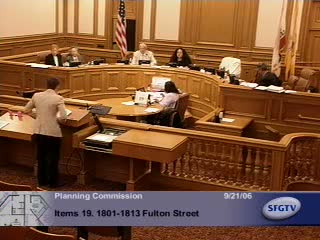
After a neighbor challenged an accessory-use determination for a rooftop microcell at 1801 Fulton Street, the Planning Commission declined to take discretionary review and approved the installation, and directed staff to schedule a broader informational review of microcell/WTS guidelines and legal context.
The Planning Commission on Sept. 21 declined a neighbors request for discretionary review of a microcell panel antenna proposed at 1801 Fulton Street and approved the installation, while directing staff to bring an informational briefing on microcell accessory-use policy and updated WTS guidance back to the commission.
Neighbor David Tornheim argued the accessory-use determinations made in the late 1990s and reaffirmed more recently were being used to avoid conditional-use notice and 500-foot neighbor notification; he asked the commission to require full notice and design review. "They've used the accessory use process to avoid going through the conditional-use hearing," Tornheim told commissioners.
T-Mobile representatives said the proposed installation is a low-power microcell (about 24 watts) intended to improve coverage over a few blocks. Paul Albritton for T-Mobile said the company met the accessory-use design guidance, provided alternative-site analyses and that radio-frequency exposure at the base of the building would be far below federal limits. "At the base of this building, the EMF would be one hundredth of what you would get from your own cell phone standing at the base of the building," Albritton said.
Commissioners balanced neighbor concerns about process and notice against federal preemption and long-standing accessory-use interpretations and voted to not take discretionary review and to approve the installation. Several commissioners asked staff to schedule an informational hearing that would include legal context, updated WTS guidelines, and technical input from carriers so the commission and public can review whether accessory-use practices need revision.
Next steps: the accessory-use determination for the specific site remains approved; staff will work with the commission to schedule an informational session on microcell policy and the WTS guidelines.