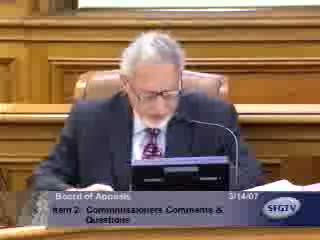
Board upholds Taxi Commission; denies Cyril Matarazzo’s medallion appeal
Loading...
Summary
The Board of Appeals upheld the Taxi Commission’s removal of Cyril Matarazzo from the medallion waiting list, finding he failed to meet progressive driving-hour requirements and repeatedly relied on time waivers, while commissioners acknowledged clerical gaps in older records.
The San Francisco Board of Appeals on March 14 upheld the Taxi Commission’s decision to remove Cyril Matarazzo from the medallion waiting list, rejecting his appeal that clerical errors and lost files dating to 1999–2000 unfairly deprived him of an opportunity to qualify.
Heidi Machin, executive director of the Taxi Commission, told the board the commission’s decision rests on the straightforward application of police-code driving-experience rules and a 2005 letter sent to waiting-list applicants that clarified the requirements. Machin said Matarazzo did not meet the driving-hours threshold during the relevant qualifying periods and had previously received multiple time waivers, which the commission later limited to prevent waiting-list stagnation.
Represented by attorney Steven Conrad, Matarazzo said his 1999 application was effectively lost, that he repeatedly followed staff guidance to request time waivers and that administrative confusion left him unable to meet overlapping, changing rules. Conrad argued the record shows attempts to comply and that lost files and informal record-keeping by earlier taxi detail staff contributed to the problem.
Commissioners pressed both sides on documentary evidence, what was communicated by taxi-detail staff versus formal commission action, and whether a clerical omission in a printed list in 2000 prejudiced the appellant. Taxi commission staff conceded some record-keeping from earlier years was informal; they also said a September 8, 2000 letter treated Matarazzo as an active applicant and that later legal changes, including Proposition K–linked rules and an ordinance updating driving requirements, increased the qualifying period progressively.
Several commissioners said the case was sympathetic but emphasized the policy goal behind driving requirements: to prioritize medallions for active, working drivers. After extended questioning and public comment, the board voted 4–1 to uphold the Taxi Commission. The decision leaves in place the commission’s determination that Matarazzo did not meet the driving requirements and therefore remains removed from the waiting list.
What happens next: the board’s decision affirms the Taxi Commission’s action. The appellant and his counsel may pursue further administrative or judicial remedies available under the city’s appeal procedures.