Get Full Government Meeting Transcripts, Videos, & Alerts Forever!
Get email alerts on the Planning Demolition topic
No spam. Unsubscribe anytime.
Planning staff urge code change to require review before residential demolitions
Summary
Planning staff proposed amending the planning code (section 3.17) to require discretionary review for most residential unit removals, codify a quantitative definition of demolition and restore a single 50% "soundness" threshold; commissioners pressed officials on appraisal timing, notice and compatibility with state rent‑control law.
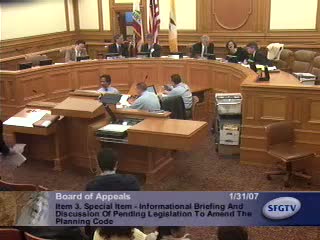
Creighton Nikitas, senior planner for the Planning Department, told the Board of Appeals that the Planning Commission will recommend an amendment to the planning code to codify a long‑standing policy requiring discretionary review for the removal of dwelling units. The draft amendment would add a new section (3.17) to the code, treat live‑work units as dwelling units for removal purposes, require replacement building permits to be approved before demolition permits issue, and adopt a three‑part, numerical definition of demolition that looks at DBI determinations, wall removals and changes in volume or floor plate.
"What it would do would be to add a new section to the planning code, section 3 17," Nikitas said, describing the measure as an attempt to protect existing rental housing stock and to prevent vacant lots created by demolitions. He told commissioners the change would revert the current telescoping soundness test to a single 50% threshold and create administrative authority for staff to update numerical thresholds set in an implementation document.
Commissioners questioned how the policy would interact with affordability goals and state law. Vice President Michael Garcia and others pressed staff on whether the rule actually preserves affordability, how credible appraisals are vetted (the proposal sets a six‑month appraisal window), and whether qualitative differences in housing quality (substandard foundations, seismic risk) would be considered; Nikitas said planners are not appraisers and recommended additional training for staff to spot questionable appraisals. He also acknowledged constraints posed by state statutes such as Costa‑Hawkins when attempting to require replacement rent‑controlled units absent a development agreement.
Public testimony included a neighborhood merchant who said the clarification between planning and building definitions of demolition was welcome. No formal action was taken; Nikitas said the Planning Commission will take up related legislation and that the Board of Supervisors is considering interim controls that would operate for six months if enacted.
The proposal is now scheduled for further consideration at the Planning Commission and in the Board of Supervisors' land use process. The Board of Appeals' role in hearing appeals could change if supervisors' interim controls are adopted, Nikitas warned.