Get Full Government Meeting Transcripts, Videos, & Alerts Forever!
Get email alerts on the Urban Forestry topic
No spam. Unsubscribe anytime.
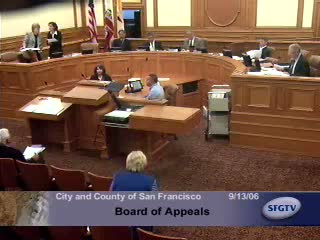
Board backs removal of 25 Junipero Serra greenbelt trees but withholds finding on who must pay for replacements
Summary
After hours of testimony from residents and arborists, the San Francisco Board of Appeals approved removal of 25 hazardous trees along Junipero Serra Boulevard for public-safety reasons, and adopted findings that leave replacement and long-term maintenance responsibility unresolved and subject to later action.
The San Francisco Board of Appeals on a unanimous vote approved the Department of Public Works' order to remove 25 trees from the greenbelt along Junipero Serra (Junipero) Boulevard, citing repeated limb failures and overall tree senescence that staff and a privately retained arborist said create a public-safety hazard.
Carla Short, bureau chief of the Department of Public Works' Bureau of Urban Forestry, told commissioners that staff and an independent certified arborist largely agreed on 24 of the 25 trees and that one tree posed an immediate risk because of a recent limb failure. Short said the bureau initially proposed removing still more trees but scaled the list back after review with the independent expert.
"We did a thorough evaluation of these trees, and the department feels strongly that they need to be removed to protect public safety," Short said.
Residents, neighborhood advocates and property owners urged the board to delay removal until a concrete plan for replacement and long-term maintenance was in place. Alan Grossman, representing the Lakeside Property Owners Association, and dozens of neighbors said the greenbelt is a neighborhood landmark and warned that removing mature pines and redwoods would create an irreversible loss of canopy, air-quality and noise-buffering benefits.
"These trees are important assets to our neighborhood and to our quality of life," said Bill Schneider, a Lakeside resident. "Taking out a 70-foot tree opens up a huge gap."
Neighbors pressed the board for information on who would pay to replace trees and how the city would ensure newly planted trees would survive the critical three-year establishment period. Short said the supervisor had identified $50,000 for removal and that the supervisor's office and DPW staff were working to identify funding sources and to install water meters and hose bibs to support future plantings, but she acknowledged the city had not yet committed to a formal planting-and-maintenance plan.
Commissioners repeatedly returned to the tension between public-safety urgency and the absence of a definitive plan for replacement and maintenance. The city attorney advised that the board could decide the removal question now and that replacement and maintenance could be handled later by the Department of Public Works or by separate permits and orders that would remain appealable to the board.
After extended public comment, a motion to uphold the portion of the DPW order authorizing removal while withholding the board's decision on maintenance responsibility carried on a 5-0 roll call. The board adopted findings prepared by the city attorney that explained the analytical basis for separating the two issues: immediate hazard removal versus longer-term responsibility for replacement and upkeep.
The board's order directs DPW to proceed with removal where the bureau identified imminent hazard; it does not order who must pay for replacement trees and instead asks DPW and the Bureau of Street Use and Mapping to continue researching historical street-acceptance records and to report back. The board noted that if DPW or another city body later decides that replacement will be performed by a private party or by the city as a matter of course, that decision will be subject to whatever permit or order process applies and therefore would be appealable.
The board's action preserves its ability to review any future orders or permits related to replacement and maintenance while allowing DPW to address trees that staff and independent experts judged to pose safety risks.
The board's written findings will be available as public record; the parties have 10 days to request rehearing.
Ending: The board's vote clears the way for DPW to remove the trees identified as hazardous. Neighbors and the association indicated they will continue to press for a replacement plan and durable commitments on watering and monitoring for young trees.