Get Full Government Meeting Transcripts, Videos, & Alerts Forever!
Get email alerts on the City Budget topic
No spam. Unsubscribe anytime.
San Francisco public commenters urge supervisors to restore cuts to youth, immigrant and community services
Summary
Hundreds of speakers pressed the Budget and Appropriations Committee to restore funding for youth programs, immigrant legal services, workers'rights outreach, SRO habitability and homelessness subsidies in response to the mayor's proposed 2024'26 budget; the committee recessed until June 26.
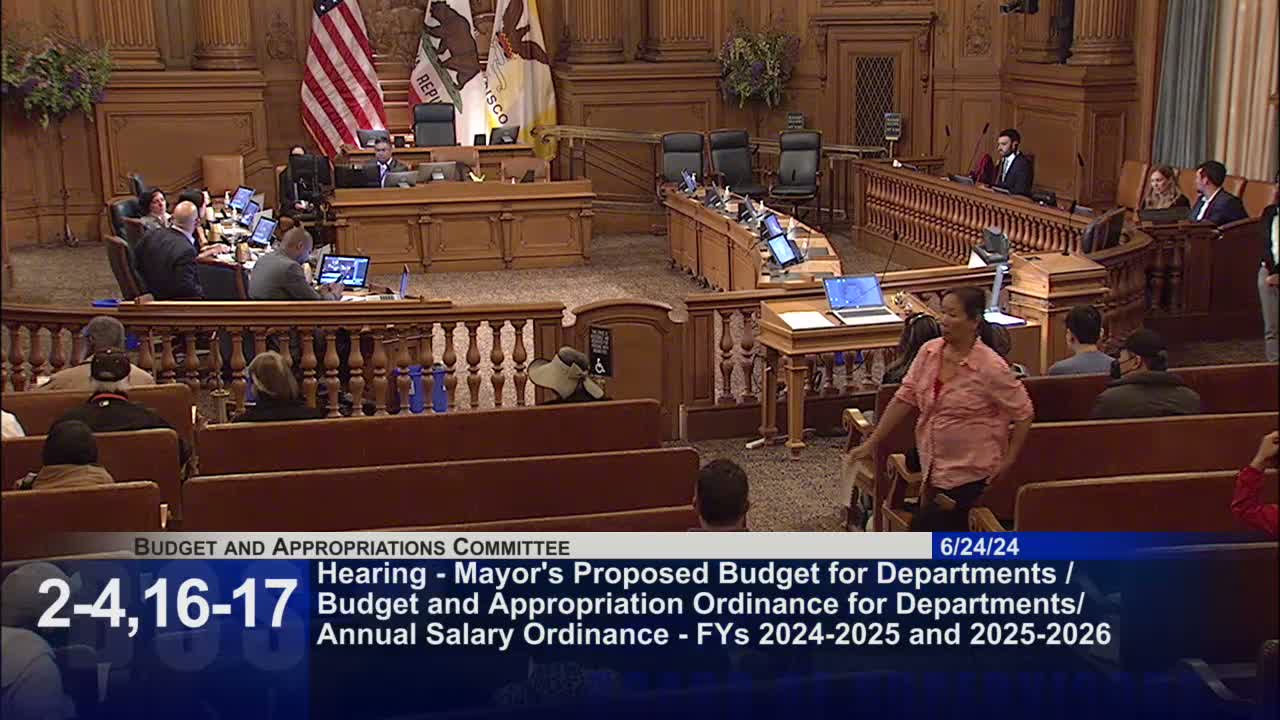
San Francisco ' Hundreds of residents and nonprofit leaders urged the Board of Supervisors' Budget and Appropriations Committee on June 24 to restore dozens of proposed cuts to youth programs, immigrant legal services, workers' rights outreach and community health grants in the mayor's proposed fiscal 2024'26 budget.
Chair Supervisor Connie Chan opened the recessed committee meeting and allotted one minute for each public commenter. "Today is a day we hear from members of the public about their reaction to the past two weeks," Chan said at the start of the hearing.
Speakers from neighborhood groups, community-based organizations and service providers described a range of threatened reductions. Youth leaders and students repeatedly asked supervisors to protect funding for the Department of Children, Youth and Families (DCYF) and the Free City college program; a youth commissioner representing the City Youth Commission said the city should "prioritize building the housing our future generations need" and restore youth leadership programming.
Nonprofit legal and immigrant defense groups testified that San Francisco's Immigrant Legal Defense Collaborative needs additional funds to meet a surge of newly arrived migrants. "When our clients have lawyers, immigration judges are far more likely to grant relief," said a representative of the Justice & Diversity Center and the collaborative. Several organizations said they could materially increase capacity with restored funding.
Workers' rights advocates and monolingual community organizers described outreach and wage-recovery work that they say would be curtailed by proposed cuts to the Workers' Rights Community Collaborative. "We win back wages and translate the law into people's own languages," said a Filipino Community Center representative. Multiple speakers reported that language-access outreach leads to recovered wages and faster habitability repairs.
Providers delivering food security, community health and soda-tax-funded Healthy Communities grants warned that reassigning those funds would halt workforce training, produce distribution and prevention programs in neighborhoods including the Tenderloin and the Excelsior. "The soda tax is not a backup budget," the director of a community farm said, adding that thousands of weekly food distributions and youth jobs would be at risk.
Speakers also urged restoration of homelessness prevention measures: Coalition on Homelessness representatives and family services providers called for $3.3 million in family flexible subsidies and $1.8 million to restore transitional-age youth subsidies, and asked the city to preserve funding for safe parking sites and a Tenderloin Urban Rest and Sleep Center that had been approved by the board but cut from the mayor's midyear revisions.
A retiree and vice president of Protect Our Benefits raised concerns about a separate decision at the Health Services Board to replace UnitedHealthcare with Blue Shield of California for Medicare Advantage plans covering retirees, saying the board projected about $20 million in savings over three years and that the process raised ethical questions.
Not all testimony opposed the mayor's proposals: trade-union speakers and downtown business advocates urged funding for a $15 million downtown recovery and a $15 million Ambassador Program to help bring conventions and visitors back to the downtown core, arguing those investments generate revenue and jobs that can support city services.
After roughly six hours of public comment, Chair Chan moved to recess the committee until 10 a.m. on June 26. The motion, seconded by Vice Chair Rafael Mendelmann, passed on a roll call with four ayes and one member absent.
The committee did not take final votes on the mayor's budget at this session; the public comment and the requests to restore funds will be part of the board's continuing budget deliberations when the committee reconvenes on June 26.