Get Full Government Meeting Transcripts, Videos, & Alerts Forever!
Get email alerts on the Budget Overview topic
No spam. Unsubscribe anytime.
Supervisors Hear Mayor—s $15.9B Budget as Officials Warn of Structural Deficit
Summary
Mayor—s proposed two-year budget totals $15.9 billion in FY24-25, with a $6.9 billion general fund and heavy reliance on one-time funds and reserves to close a roughly $789 million gap; the controller cautioned a persistent structural deficit of about $800 million and urged future difficult choices.
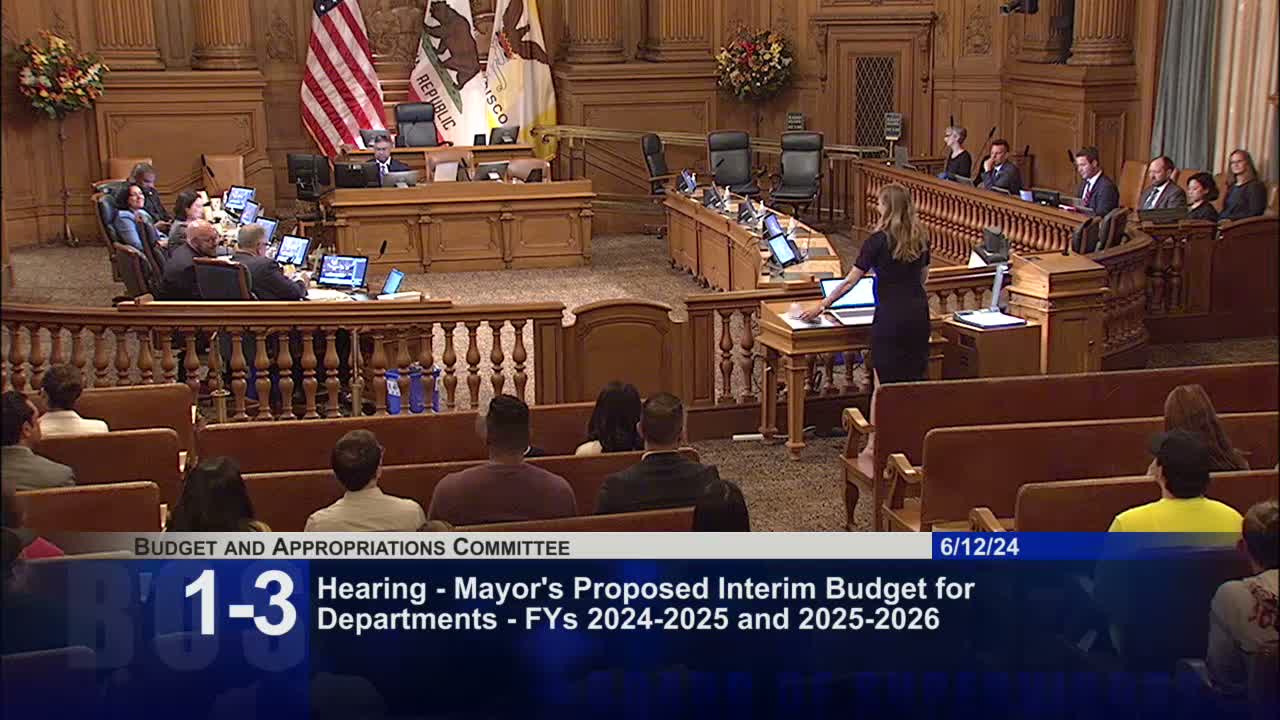
Chair Supervisor Connie Chan convened the Budget and Appropriation Committee on June 12 to review the mayor—s proposed interim and two-year budgets. Mayor—s Budget Director Anna Dooney told the committee the proposed FY24-25 budget totals $15.9 billion, including a general fund of about $6.9 billion and targeted investments in employee wages and homelessness services.
The presentation and follow-up analysis from City Controller Greg Wagner focused on the plan—s heavy use of one-time solutions. Dooney said the mayor—s proposal balances a roughly $789 million gap using a mix of reserves, prior-year balances and one-time department revenues; Wagner told the committee the revenue assumptions are broadly reasonable, but warned that the plan relies on about $1 billion of one-time solutions over two years and that a structural deficit on the order of $800 million likely remains beyond the budget window.
Wagner pointed to specific items in the administration—s balancing plan: a $445 million drawdown of prior-year fund balance, about $235.7 million of FEMA reimbursements assumed, $138.3 million from reserves and $82.5 million of other one-time general-fund-supported revenue. He also noted $137 million of short-term cost shifts to other funds that reduce the general-fund gap only temporarily.
The budget nonetheless includes several notable investments. The mayor proposes multi-year wage increases (a 13% schedule for miscellaneous employees over three years and a $25 minimum for city employees), increased shelter and homelessness supports for families, expanded early childhood investments, and targeted public-safety staffing. The mayor—s presentation emphasized that many of the enhancements are one-time or funded with non-general-fund revenues.
Supervisors pressed the administration on the sources of the balancing plan and the implications of large one-time draws. Chair Chan emphasized the committee—s responsibility to scrutinize tradeoffs and prioritize core services for seniors, children and food-insecure residents.
What happens next: the committee filed the interim budget item and forwarded the related ordinances to the full Board of Supervisors with a positive recommendation. Staff and the controller flagged specific reserve uses that will require monitoring and potential follow-up legislation if revenues or legal assumptions change.