Get Full Government Meeting Transcripts, Videos, & Alerts Forever!
Get email alerts on the Homelessness topic
No spam. Unsubscribe anytime.
City hears HSH budget plan to acquire supportive housing and expand vouchers; oversight panel urges different allocations
Summary
HSH proposed roughly $1.27 billion over two years for acquisitions, 906 new housing choice vouchers, expanded subsidies and emergency shelter. The Our City, Our Home oversight committee urged set‑asides for non‑SIP hotel residents, bridge housing and emergency hotel vouchers; supervisors pressed HSH about safe‑sleep costs and targeting.
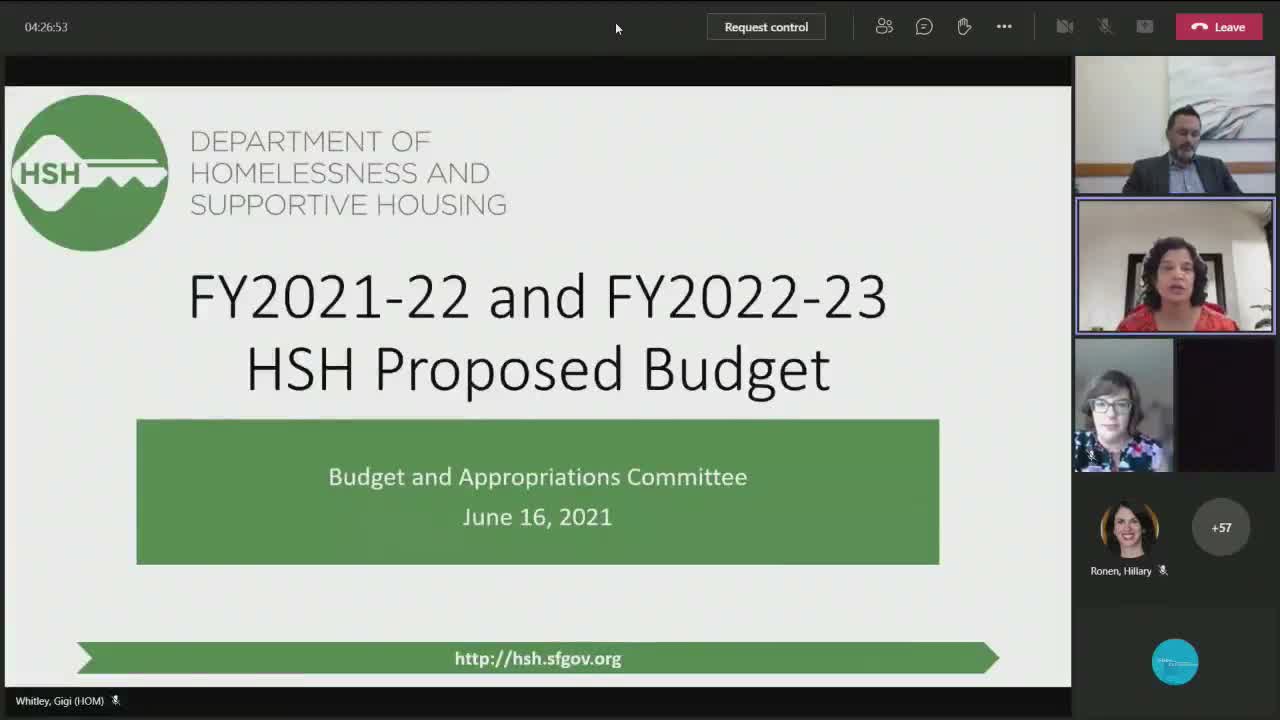
Shereen McSpadden, director of the Department of Homelessness & Supportive Housing, presented the mayor’s homelessness proposal, describing a two‑year package that would fund acquisitions of permanent supportive housing (roughly 800–1,000 units), expand flex subsidy pools by about 1,500 units, provide medium‑term subsidies and implement 906 new Housing Choice Vouchers. McSpadden said the combined investments would enable up to 2,500–3,000 new placements and support housing stability for roughly 8,000 households.
The plan also funds expanded emergency shelter models, two additional safe‑parking sites, continued safe‑sleep operations with temporary noncongregate shelter capacity and the purchase of the Polk Street Navigation Center (888 Post) as part of a broader acquisitions push.
Tension between oversight and mayoral plan: A citizen oversight body for the Our City, Our Home (OCOH) package urged a different mix of spending — prioritizing set‑asides for people still living on the street (non‑SIP residents), bridge housing for transitional‑age youth and emergency hotel vouchers for domestic‑violence survivors and pregnant people. OCOH said the mayor’s proposal moved significant funds into acquisitions but cut some prevention and subpopulation set‑asides; Jennifer Friedenbach (OCOH) asked for those carve‑outs to be restored so specific vulnerable groups would not be crowded out by flexible pots.
Controversial line‑item: Safe‑sleep/tent sites. Supervisors asked about the HSH line for temporary noncongregate safe‑sleep sites (about $15,000,000 in year‑one in the proposal). Several members pushed HSH to justify the per‑site cost and accelerated demobilization plans; Supervisor Ronan said $57,000 per tent (as budgeted) “seems excessive” and urged HSH to shorten the period of reliance on that model and reallocate funds to faster exit paths. HSH acknowledged the sites are expensive and framed them as an interim element while SIP hotel exits and acquisitions proceed.
Budget & implementation questions: Supervisors and advocates pressed HSH on how the new dollars would be implemented, the capacity of HSH to spend large capital dollars quickly, and whether vouchers or subsidies would prioritize people not already in SIP hotels. McSpadden said the department is increasing staffing and technology capacity and pursuing an acquisitions strike team to identify purchases. She also explained constraints in using certain revenue streams for operating costs and said the department would work with the Board on allocation mechanics.
What’s next: The committee approved moving HSH’s expenditure plan to the full Board with a positive recommendation, but supervisors signaled they expect continued hearings on specific allocations and close follow‑up on HSH’s plans to reduce dependence on expensive interim models.