Get Full Government Meeting Transcripts, Videos, & Alerts Forever!
Get email alerts on the Dem Covid topic
No spam. Unsubscribe anytime.
DEM tells supervisors pandemic lessons: translation, disaster workers and HSOC coordination
Summary
DEM said its COVID command work — mass translations, disaster‑service worker mobilization, and neighborhood outreach — changed how the city handles emergencies. Supervisors pressed DEM on HSOC's role in encampment work, coordination with police, and next steps for shelter exits and long‑term encampment strategies.
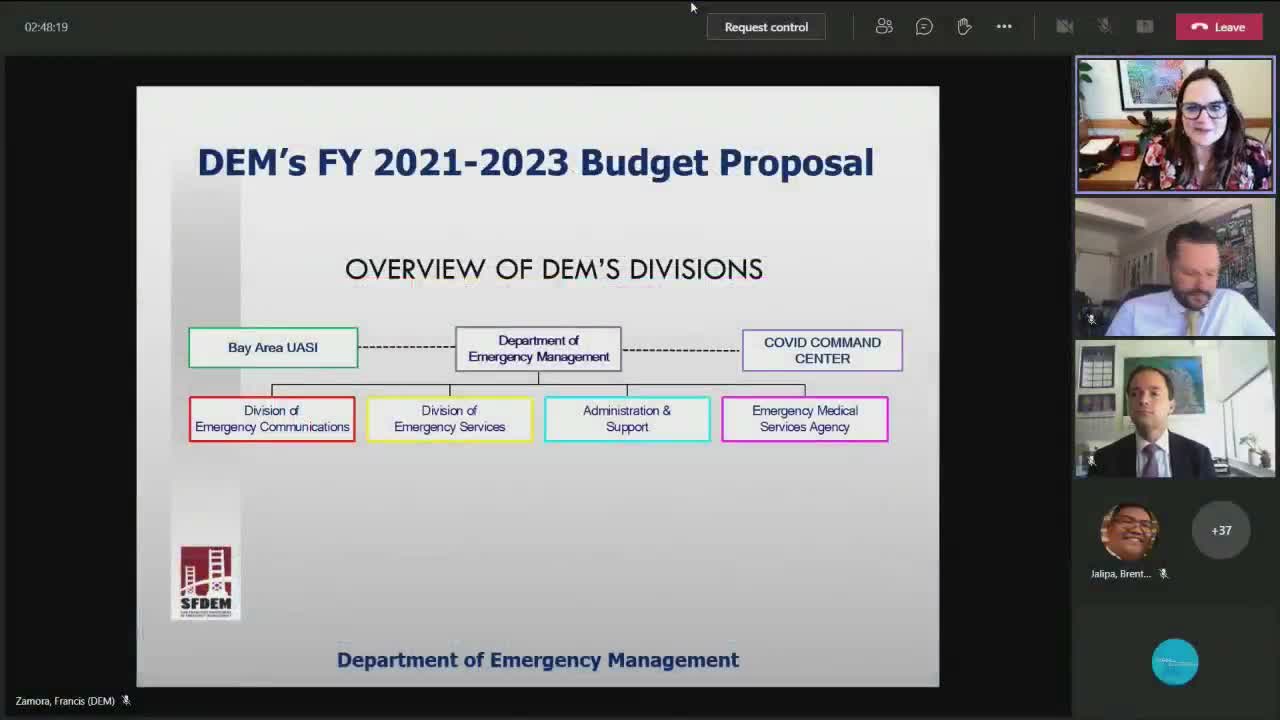
Mary Ellen Carroll, executive director of the Department of Emergency Management, told the Budget Committee that the department’s pandemic role reshaped the city’s emergency operations and its approach to equity. Carroll said DEM translated more than 5,200 documents and materials during COVID, used human review rather than pure machine translation, and mobilized nearly 5,000 disaster‑service workers for up to 11,000 deployments, praising their localized community knowledge.
Carroll described HSOC (Healthy Streets Operations Center) as a DEM‑hosted, multi‑agency coordination body used during the pandemic to focus resources on large encampments and life‑threatening situations. She said HSOC reduced large encampment counts dramatically (from 66 to 9 between April 2020 and April 2021) by combining shelter placements, community outreach and interagency operations. Supervisors asked how HSOC will operate going forward, who leads neighborhood‑scale responses, and how police involvement will change.
Why it matters: Supervisors want clarity about when to deploy public-health teams vs. police, how to create shelter exits off sidewalks, and which entity is responsible for recurring cleanups and smaller encampments. Director Carroll said DEM will keep HSOC housed in DEM and will continue coordination with HSH, DPH, MTA and PD, while she emphasized the need for continued community partnerships and an evaluation of lessons learned.
Key details - DEM proposed two‑year budget includes $122.6M request over two years, roughly 64% general fund and the rest grant‑funded; year‑one COVID response allocation ~ $7.9M and a $12M multi‑year CAD replacement project in later year. - Translation: DEM said it used human translation verification and monthly meetings with a Language Access Network; dispatch (DEC/9‑1‑1) has a primary and backup translation service plus ~25% bilingual certified dispatchers. - HSOC: Carroll said HSOC remains collaborative and will be part of DEM but not a separate department; operational leadership for daily encampment coordination comes from HSH and partners; DEM supports coordination and 9‑1‑1 operations and data-driven incident response.
Committee follow-up Supervisors asked DEM for: a written timeline for COVID command drawdown (Chair Haney was told COVID Command ends June 30 and operations shift back to EOC), data on Disaster Service Worker deployments and lessons learned, and plans for HSOC staffing and roles in smaller vs. larger encampments. Carroll committed to after‑action reviews and further briefings.