Get Full Government Meeting Transcripts, Videos, & Alerts Forever!
Get email alerts on the City Budget Policy topic
No spam. Unsubscribe anytime.
Committee accepts BLA technical savings, debates Moscone incentives and 311 call‑diversion staffing
Summary
Supervisors signaled intent to accept BLA reductions across many departments but spent extended time on two policy issues: whether to fund Moscone rental incentives as a two‑year recovery measure and how many 311 call‑diversion call‑takers to authorize now versus reserve. The Office of Economic and Workforce Development and the BLA disagreed over two small‑business permitting specialists.
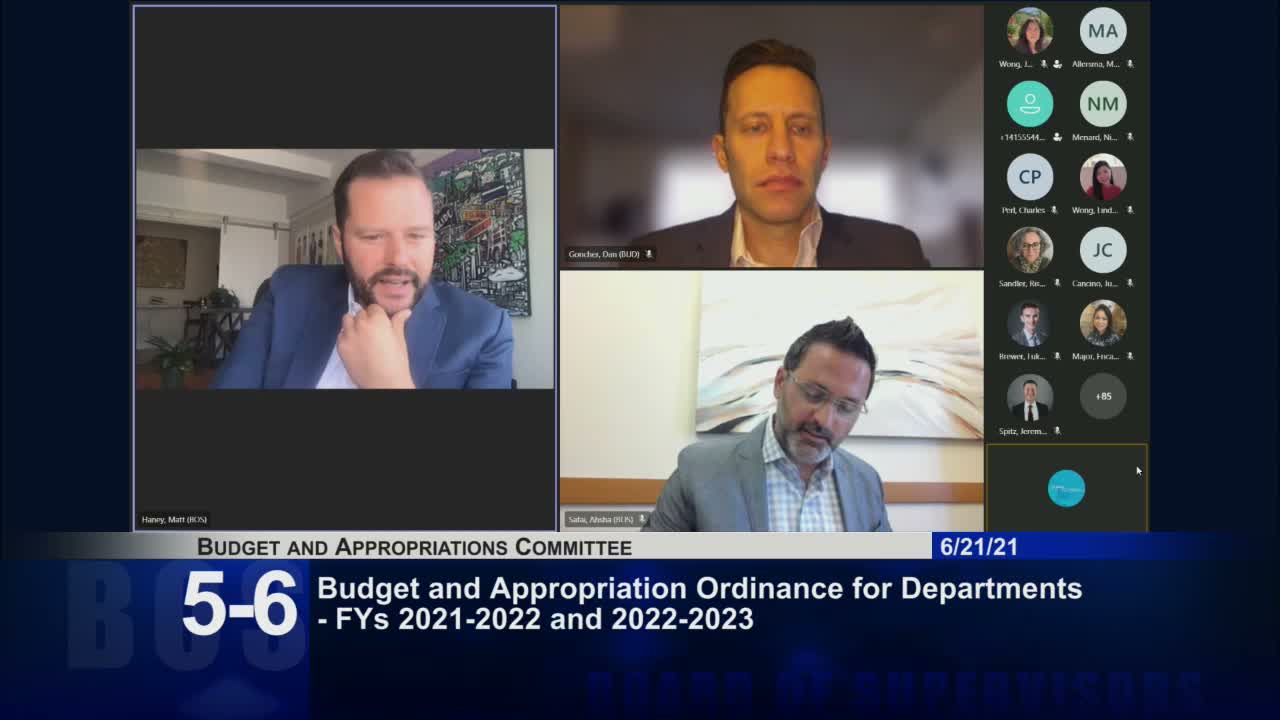
At its June 21 hearing the Budget and Appropriations Committee expressed broad agreement with the Budget Legislative Analyst’s recommended reductions for many departments but flagged several policy choices for further consideration.
The Committee and staff repeatedly accepted BLA technical recommendations for departments including the Department of Building Inspection, City Planning, Public Works, the City Attorney, the Controller, Elections and others. Dan Goncher of the Budget Legislative Analyst’s Office enumerated planned reductions and noted where the BLA and departments had reached agreement.
Two policy issues drew more sustained debate. First, the City Administrator and tourism partners argued for a two‑year stopgap to fund Moscone rental incentives intended to help San Francisco compete for convention bookings while hotel tax revenues recover. The BLA recommended deleting roughly $2.6 million in year 1 and about $2.0 million in year 2 pending clearer evidence that incentives would convert tentative bookings into firm contracts. City Administrator Chiu said incentives could produce hundreds of thousands of room nights and tens of millions in direct spending and urged the board to view the request as an economic recovery tool.
Second, supervisors pressed 311 Director Nancy Alfaro and the BLA about the call‑diversion plan to transfer certain nonurgent (“priority C”) calls from 911 to 311. Alfaro said the administration requested 10 new call‑taker positions, agreed to cut two with the BLA, and proposed placing eight on reserve while releasing three immediately. Alfaro and others warned that hiring and training take time — typically six to nine months — and that the city needs a project manager and cross‑departmental decisions about which call types will be transferred. Supervisors asked how quickly callers could be diverted and how residents would be educated about the new routing.
A separate policy dispute involved two proposed small‑business permitting specialists in the Office of Economic and Workforce Development (OEWD). The BLA recommended denying the new positions because the Permit Center already has nine generalist FTEs and there is a risk of redundancy; OEWD Director Kate Sophas said the proposed specialists would provide sustained, sector‑specific “concierge” assistance to very small businesses and create a feedback loop to identify permitting bottlenecks. The committee accepted the BLA’s technical recommendations but continued the policy questions for further review before final action.
Direct quotes from the hearing include Dan Goncher’s budget summary and Nancy Alfaro on training timelines: "We asked for 10 positions, and we have agreed to release 2 of those," Alfaro said; "6 to 9 months to train. It's not like we can ramp up very quickly." The committee said it will finalize policy decisions in subsequent hearings.
What’s next: The committee intends to accept many departmental budgets with BLA recommendations and will resolve the flagged policy items (Moscone incentives, 311 staffing, OEWD positions) prior to final July hearings.