Get Full Government Meeting Transcripts, Videos, & Alerts Forever!
Get email alerts on the Police Budget topic
No spam. Unsubscribe anytime.
Supervisors Press Police, Ask for Data as SFPD Seeks 100 Recruits and Technology Funds
Summary
San Francisco Police Chief William Scott asked the Budget Committee for 100 sworn recruits, 10 civilian transparency positions and technology upgrades, arguing staffing is needed to respond to rising gun and property crime. Supervisors pressed for clarity on year-to-year totals, overtime and how alternative response teams will change police workloads.
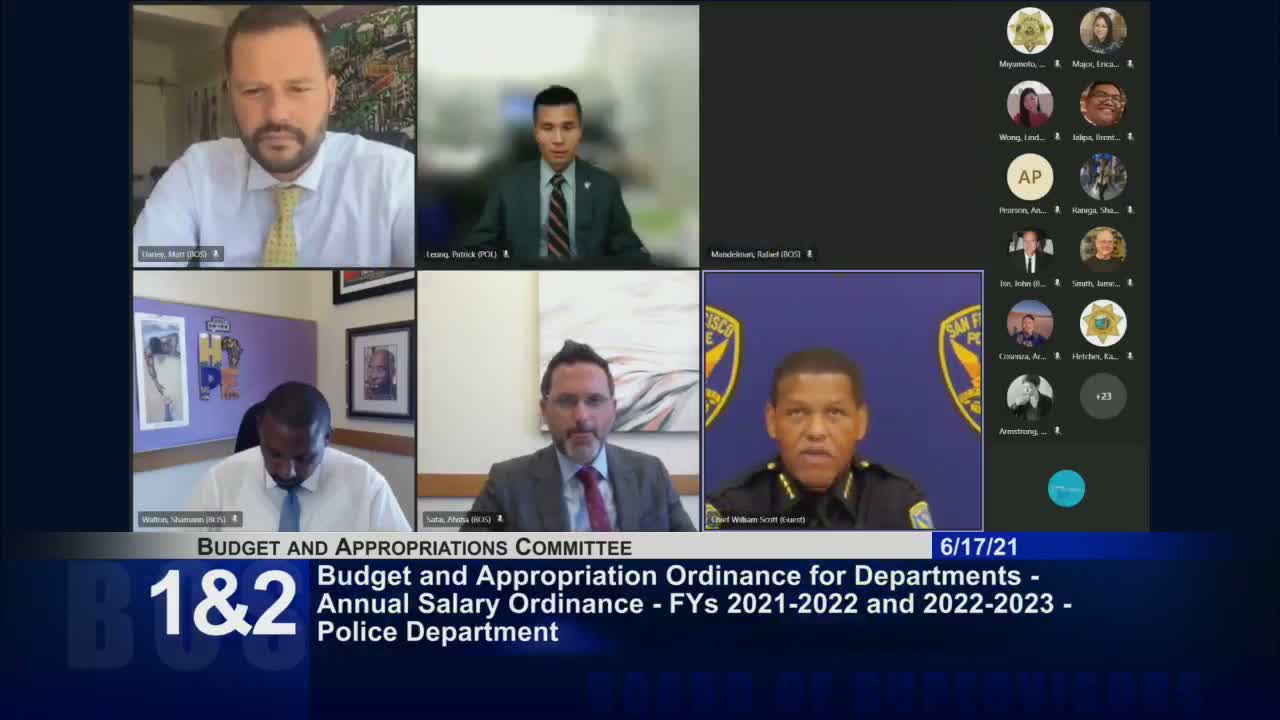
San Francisco Police Chief William Scott told the Budget and Appropriations Committee on June 17 that the department needs 100 new sworn hires and 10 civilian positions to meet transparency obligations under California law and to sustain response levels as crime patterns change. The department also asked for technology modernization now and in a larger follow-up request next year, including funds to replace the records-management system and support data-driven reform work.
"We know what it takes—we just need the support to get us there," Chief Scott said, outlining a staffing analysis that recommended a long-term increase of roughly 265 officers across field operations. He said the 100-recruit ask was intended primarily to hold the department steady in the face of historically high yearly attrition (about 95–105 separations per year).
Why it matters: City supervisors highlighted competing priorities: many board members support reimagining public safety and shifting some noncriminal responses to community health teams, yet they also pushed the police to explain how its requests would be reconciled with plans for alternative responders such as the Street Crisis Response Team.
Key details - Hiring: The police asked for 100 sworn recruits (estimated FY22 cost presented at ~$5.1 million) and 10 civilian hires aimed at SB 1421 transparency compliance; the civilians would handle public- records workloads now being done by sworn staff. Chief Scott said the 100 sworn hires largely replace expected yearly attrition, not a net expansion beyond prior staffing levels. - Technology: Scott said a year‑one ask for technology is $1.5 million (budget office proposed $1.5 million of a $3 million need), with a substantially larger modernization request in year two (roughly $12.6 million) to replace the records-management system, body-worn-camera infrastructure and other analytics platforms needed to complete collaborative reform recommendations. - Overtime and budgets: CFO Patrick Leung explained the proposed two-year budget shows a modest overall decrease this year compared with the current fiscal total (driven by non‑general-fund reductions, notably airport funds), while general‑fund-supported policing would rise modestly. Scott and the CFO said overtime was under pressure in 2020–21 (current-year overtime spending rose to ~$15.8 million year‑to‑date against a lower budget) but the department sought a FY22 overtime allocation of about $15.6 million to stabilize operations.
Supervisors’ questions and concerns Supervisors pressed the chief on several points: the reason for a step‑down in total budget this year yet a large ramp in year two (timing and capital projects are key drivers); whether the department can deliver community policing practices (foot patrols) while staffing large numbers of sector cars that respond to 911 calls; and whether alternative response programs (mental‑health teams, Street Crisis Response Team) can materially reduce sworn workload and thus be reflected as savings in later budgets. Chief Scott repeatedly emphasized a blended approach: community responses must grow, but a baseline of sworn staffing is still necessary to address violent and organized crime.
What’s next Supervisors asked the police and the mayor’s budget office for additional line‑item detail, including vacant civilian and sworn counts and the timing of capital and technology requests. The discussion set the frame for follow‑up meetings on Prop E staffing methodology and the department’s multi‑year modernization plan.