Get Full Government Meeting Transcripts, Videos, & Alerts Forever!
Get email alerts on the Homelessness Safe Sleep topic
No spam. Unsubscribe anytime.
Supervisors press HSH on high cost of safe-sleep sites as Prop C funds are reallocated
Summary
Supervisors questioned HSH over proposed safe-sleep allocations (reported $15M year 1, $5M year 2) and an apparent $57,000 per-tent annual cost; HSH said expenses reflect staffing, meals, toilets, utilities and CBO contracts and confirmed these expenditures are funded through Prop C.
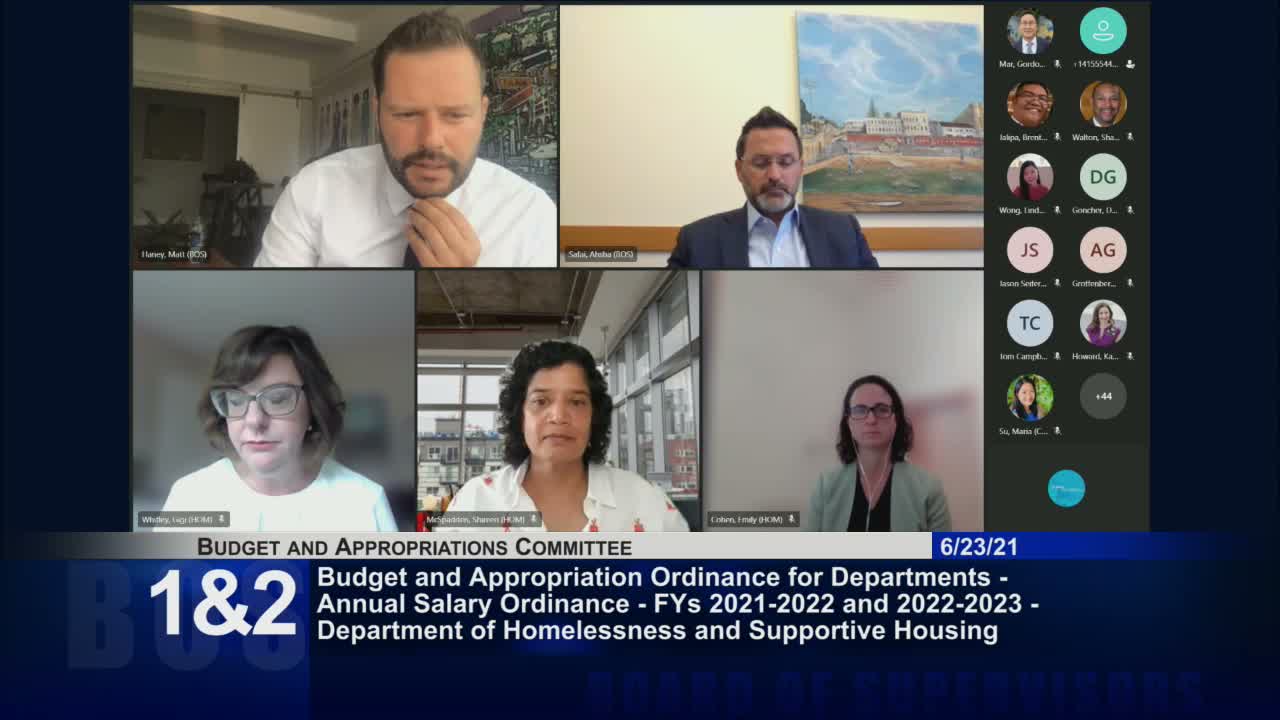
Supervisors on the Budget and Appropriations Committee pressed the Department of Homelessness and Supportive Housing (HSH) on June 23 about the expense of safe-sleep sites, even as the committee moved to release Prop C reserves that fund broader housing and prevention initiatives.
Supervisor Safaie and Supervisor Ronan focused on the safe-sleep funding line—$15,000,000 proposed for year one and $5,000,000 for year two—and asked whether the city was paying roughly $57,000 per tent per year when those totals are amortized against planned capacity. "When you factor in 260 beds ... that's $57,000 per tent," Supervisor Safaie said, urging that the committee continue conversations to reduce cost per client.
Deputy Director Gigi Whitley explained the higher cost per tent stems from emergency, site-based expenses driven by 24-hour staffing, rented toilets and showers, utilities, on-site meals and contracts with community-based organizations for security and services. Whitley said the program was stood up under the COVID Command Center and will transfer to HSH on July 1; the Department expects opportunities to streamline costs once the program is fully integrated into its operations.
Whitley noted that in the current emergency model six sites run at an average of about $18.2 million total (roughly a $190 per tent per night average), and that the budget as proposed already includes a built-in reduction and steeper wind-down in year two. She said the program is funded from Prop C, and supervisors argued this committee should continue to press for cost reductions as sites transition back into the department’s oversight.
Supervisors and department staff also discussed transition plans for people in safe-sleep sites and interactions with shelter and navigation-center capacity; HSH said the shelters will be "re-inflated" carefully in partnership with DPH to ensure safety and that they are preserving a mix of tools—hotels, safe-sleep and safe-parking—to move people into more permanent options as capacity and public-health guidance permit.
The committee asked HSH to continue work on cost control, vendor negotiations, procurement of lower-cost sanitation options where feasible, and to return with additional cost comparisons prior to final budget action.