Get Full Government Meeting Transcripts, Videos, & Alerts Forever!
Get email alerts on the Capital Plan topic
No spam. Unsubscribe anytime.
Officials present $41 billion 10-year capital plan, emphasize resilience and seismic safety
Summary
City staff presented an updated 10-year capital plan that projects roughly $41 billion in investment over the next decade, highlights seismic retrofits, affordable housing, public health clinics and resilience projects, and describes constraints tied to bond capacity and property values.
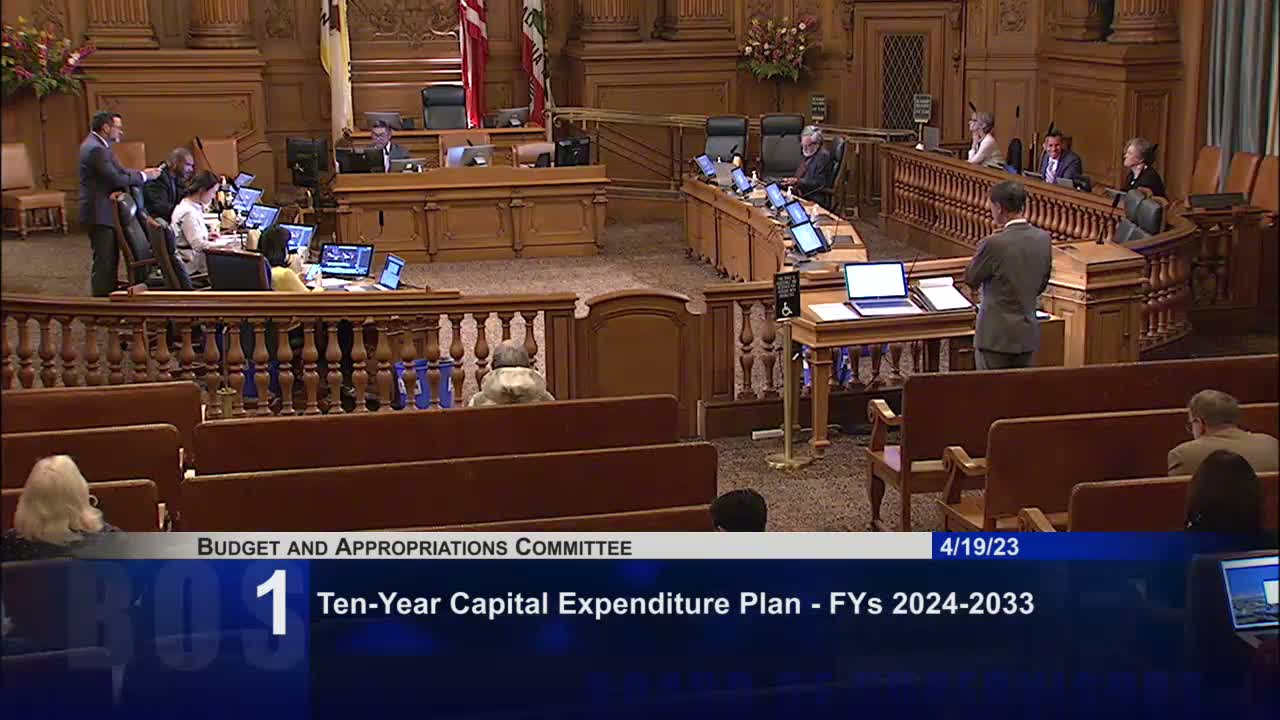
City capital planning staff told the Budget and Appropriation Committee that the 10-year capital plan lays out about $41 billion in proposed investment across multiple city functions, including general-fund department projects, enterprise agency work and externally controlled entities.
Brian Strong of the Office of the City Administrator outlined the plan—s three main funding components: the general obligation bond program (a key source for many general-fund projects), certificates of participation (general-fund debt) and revenue bonds for enterprise departments. He said the plan seeks to be constrained and prioritized so the city funds core life-safety work, resilience, asset preservation and programmatic needs.
Strong highlighted recent accomplishments funded through the capital program: roughly 2,600 new affordable housing units since 2020, completion of public health facilities and seismic retrofits, neighborhood park investments, and significant street and sidewalk work. He said the plan identifies projects that address life-safety and resilience, including clinic and shelter upgrades, and emphasized that debt policy has limited issuance until older debt is retired to avoid raising tax rates.
The presentation identified upcoming proposed bonds (public health, affordable housing/homelessness, transportation and others), explained that capacity is constrained through the mid-2020s, and noted that delays in issuing bonds raise long-term costs because debt service commitments typically last 20—25 years. Staff also outlined the pay-as-you-go component and a target to move paygo funding toward pre-pandemic levels.