Get Full Government Meeting Transcripts, Videos, & Alerts Forever!
Get email alerts on the Federal Stimulus Arpa topic
No spam. Unsubscribe anytime.
San Francisco committee hears ARPA briefing; public urges $136M for climate resilience
Summary
The Budget & Appropriations Committee received a Controller's Office briefing on federal stimulus (ARPA) and related uncertainties about allowable uses and timing. Dozens of public callers urged dedicating a substantial portion of local recovery funds to climate resilience; the committee continued the item to the call of the chair (5-0).
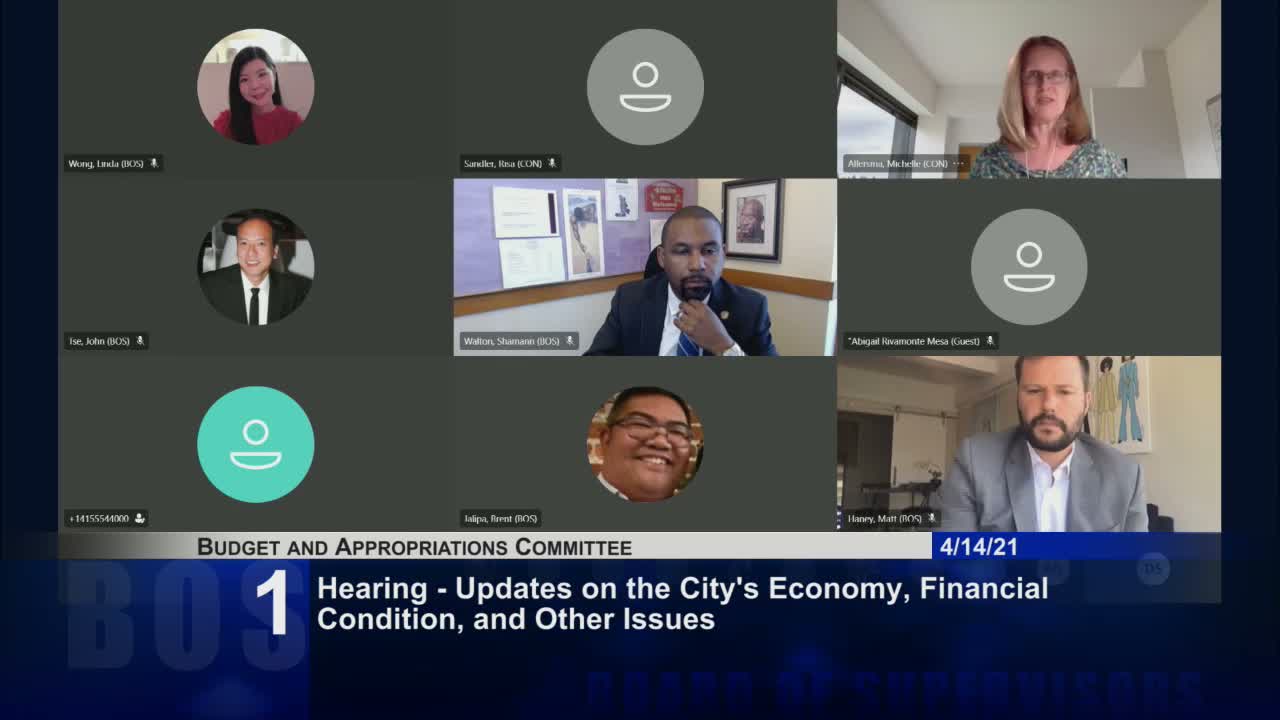
San Francisco's Budget & Appropriations Committee on April 14 heard a briefing from the Controller's Office on recently enacted federal stimulus packages, with an emphasis on the $1.9 trillion American Rescue Plan Act (ARPA), and fielded public pleas to prioritize climate-resilience spending from the city's local recovery allocation.
Michelle Alersma of the Controller's Office told the committee ARPA includes a new, widely watched provision that allows local governments to document and replace revenue losses. "This is essentially revenue backfill," she said, adding that jurisdictions "can document our revenue losses and use the funding to fulfill those losses." Alersma warned that important restrictions remain: ARPA funds may not be used to offset tax cuts, cannot be deposited into pension funds, and must be obligated by Dec. 31, 2024. She said the U.S. Treasury is expected to publish further guidance in early May and has set up an Office of Recovery Programs to coordinate implementation.
Alersma offered preliminary local estimates published by the White House and Treasury: San Francisco's allocation from the coronavirus local fiscal recovery fund is listed at roughly $636,000,000. She described provisional, entity-level figures including roughly $300 million for the Municipal Transportation Agency, about $192 million for the airport, $112 million for the San Francisco Unified School District, just under $29 million for City College, and an estimate of about $20 million for housing programs. She cautioned these numbers are subject to change and that many funds will flow through pass-through grants from state and federal agencies rather than directly to the city.
Supervisors pressed for clarity on how much the state will receive and whether state pass-throughs would add materially to San Francisco's total available funds. Alersma said state allocations and pass-through details remain unclear and offered to return with a chart of pass-through possibilities. The Controller's Office and the mayor's budget office said they had assumed, for the city's five-year financial projection, that the local aid could be used for revenue replacement, but they noted that final guidance could change that assumption.
Public callers used the item's comment period to press the board to earmark a significant portion of the local recovery allocation for climate and resilience work. Gabe Goffman of District 2 asked supervisors to "put the $136,000,000 of the $634,000,000 stimulus money into a fund for equitable climate change mitigation and resilience," citing wildfire risk and job-training opportunities. Other callers echoed the request, urging the board to allocate about 1% of the city's overall budget or to prioritize investments in electrification, waterfront contamination remediation, expanded transit and bike infrastructure, and community-based alternatives to policing.
After public comment, Chair Matt Haney moved to continue the item "to the call of the Chair," a motion seconded by Vice Chair Safaie. The committee approved the continuation by voice roll call, 5-0. No formal policy decisions or spending allocations were taken at the meeting; the committee said it would follow up with additional detail on state pass-throughs and the five-year financial projection when those items return for consideration.
The committee is expected to resume detailed discussion when the mayor's five-year financial update is heard next week and as Treasury issues guidance on ARPA certification and allowable uses.